

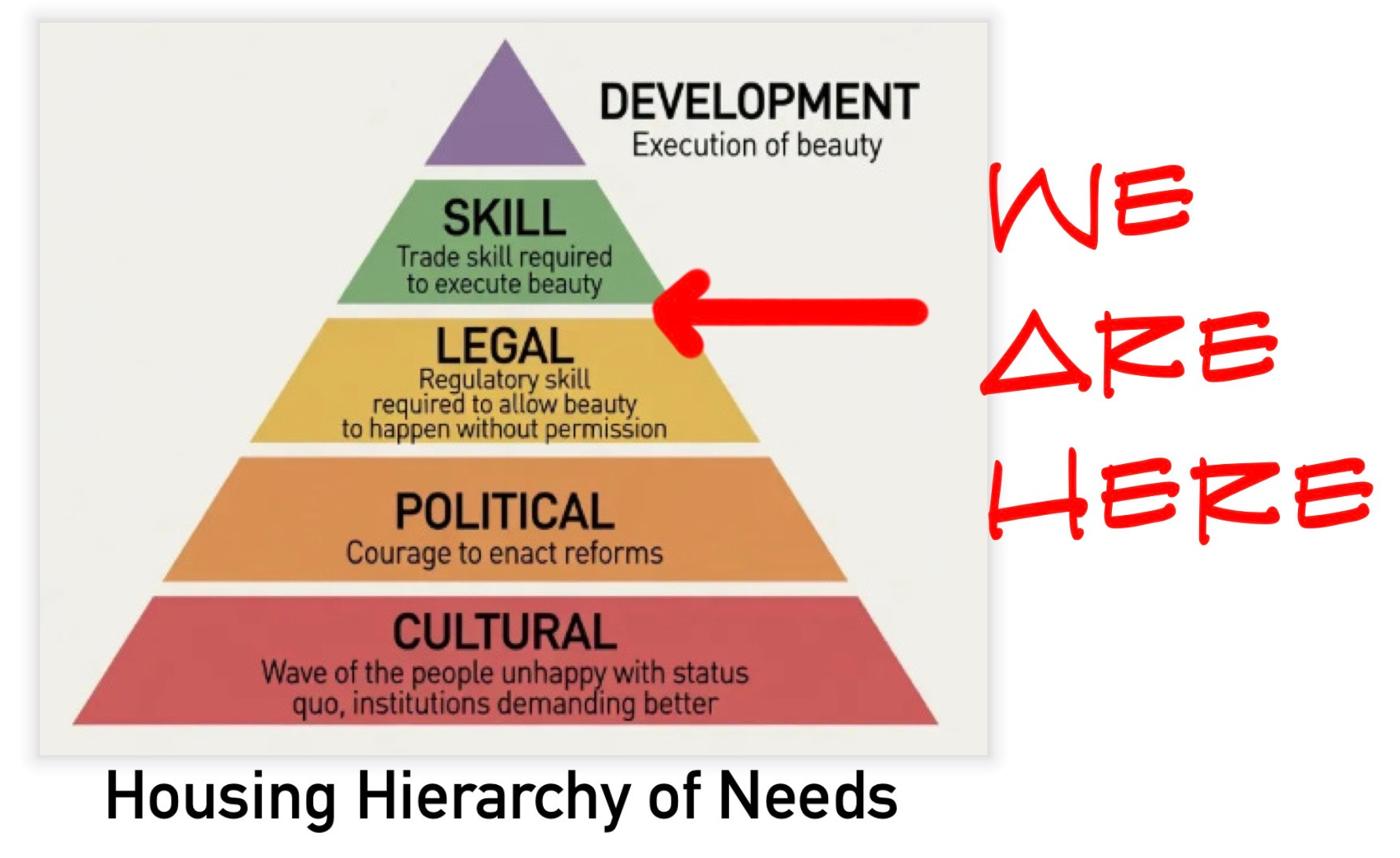
Earlier this year, I introduced Lubeck’s Hierarchy of Housing Needs, an adaptation of Maslow’s framework for rebuilding beautiful, abundant places. The core claim was simple: great development results from preconditions that must be met in sequence. Cultural discontent and institutional pressure come first. Political will follows. Legal freedom comes next. Then—and only then—can skilled execution emerge at scale. Only after all the preconditions are met does the actual development of beautiful places become possible.
In this context, we can begin discussing the final phase of YIMBYism.
This Housing Hierarchy has five levels:
Cultural — frustration with current development patterns, coupled with a desire for better places, more choices, and human-scale urbanism
Political — prioritization by elected officials on housing supply and placemaking
Legal — implementation of rules and codes to make good development legal and feasible again
Skill / Pedagogy — instruction for the designers, builders, developers, and the schools that train them
Development — actual construction of beautiful, abundant places
The ultimate goal sits at the top—Level 5: Development. Everything else is supportive. In other words, it is entirely possible to win the cultural argument, pass the bills, and rewrite the codes—and still not build the places we want. That is where we are in 2026.
Great development is the end result of preconditions that must be met in sequence.
Looking at the last fifteen years of YIMBY growth, the progress on the lower three levels is real and historically unprecedented. Zoning has moved from a niche, nerdy technical subject to something presidential candidates discuss at debates. The YIMBY movement is national. State and local reforms have relegalized missing-middle housing types that planners had effectively banned for decades. The cultural case for abundance and consumer choice is stronger than it has been in a generation. None of this was inevitable, and it would have been hard to imagine in 2011. We should credit that work without qualification.
We are solidly on the foundation of the first three rungs of the hierarchy. We remain thin on the last two.
WHERE WE GO FROM HERE
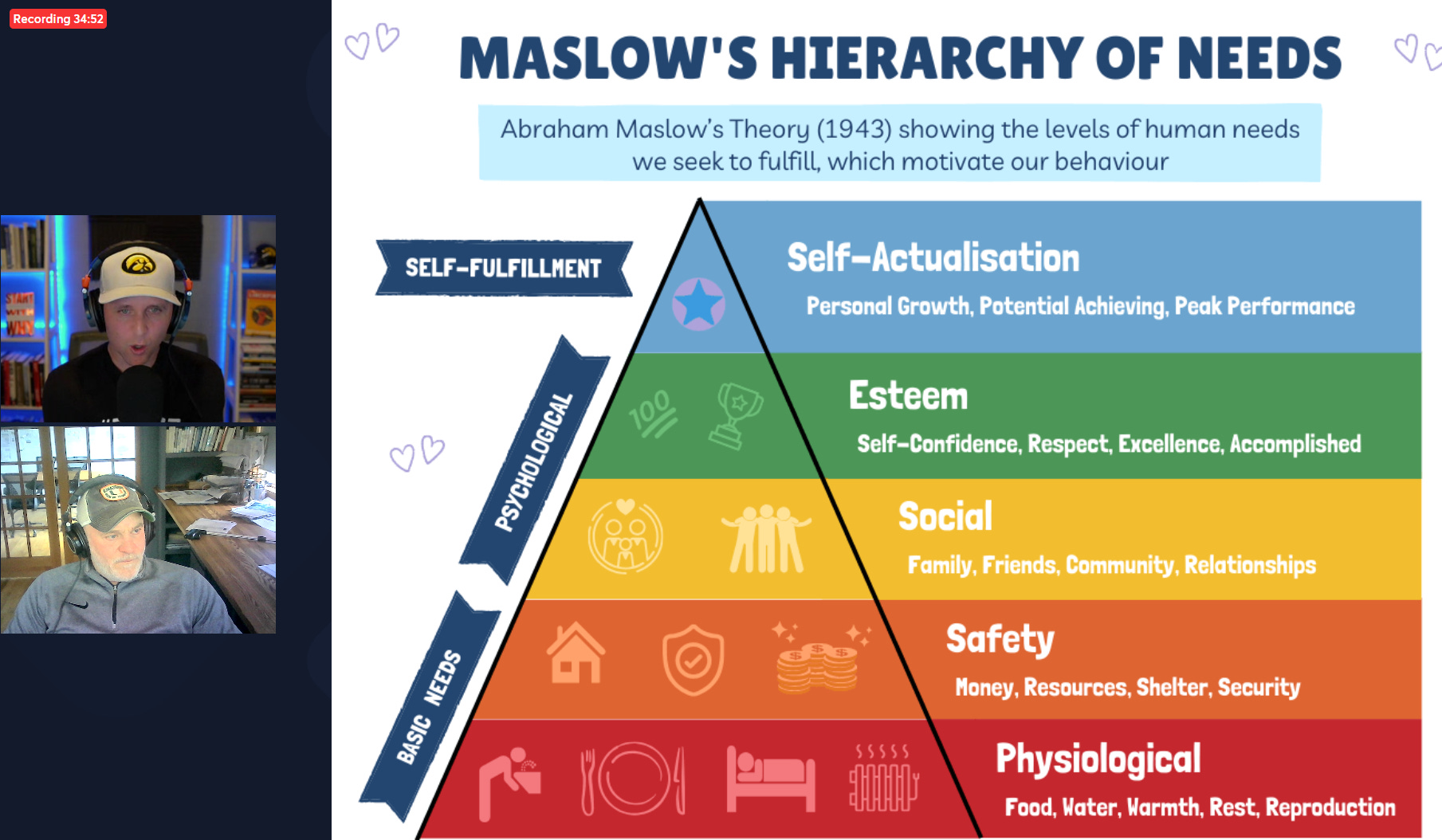
I recently recorded an episode of the Land Development Podcast with Ryan Glick, where we worked through exactly this question. (The episode should be available in December.) Three conclusions stood out.
First, the end goal is level 5: building abundant and beautiful places.
We can have more housing and beautiful housing, and there should be no reason to compromise on either. 100% of the actual production of that outcome happens at the top of the hierarchy. Reform, organizing, and education are necessary, but they are not the finish line. It is possible to succeed at all of them and still not build the housing—let alone the beautiful housing—we need.
Second, there is currently a relatively hard line between levels 3 and 4.
Levels 1-3 are primarily the advocate’s world. Levels 4 & 5 are primarily the practitioner’s world. There is currently a hard line between the two. The line is hard because the skills are different, not because one side is superior. Many of the most effective people over the next decade will be Renaissance men and women who can operate across all five levels. In practice, very few currently do. Crossing that bridge—practitioners entering advocacy, and advocates entering the practice—is one of the higher-leverage moves available to the movement right now.
Third, we are strong on culture, politics, and law, and weak on talent and the institutions that build places.
Ask two questions. Does your city have a large bench of people who know how to design, build, develop, and manage the missing-middle and human-scale housing we have spent the last decade relegalizing? And do our educational institutions have any serious commitment to training that bench? The honest answer to both is no.
“Nobody is coming to save you.”
- common practitioner saying
There are still very few people in most cities who are fluent in duplexes, pocket neighborhoods, live-work units, or the other building types that used to be ordinary. Architecture schools continue to emphasize how to design budgetless civic buildings and rationalize sweeping modernist narratives. Most real estate development programs train people to optimize spreadsheets rather than how to build quality places. The placemaking pipeline is thin.
“If we want to change how our cities and towns work, we need to change the people who run them. We need a new generation of city builders—architects, engineers, planners, developers, city managers, and civic leaders. We need a new school for city builders.”
- Seth Zeren, A New School for Citybuilders
That is beginning to change in a few places. The Incremental Development Alliance (where I teach) has trained more than 10,000 small developers over the last decade. Practitioner-advocates such as Seth Zeren are exploring the creation of a flagship school dedicated to advanced training of city builders. Brett Jones is helping Florida stand up its first college degree in city building, with plans to open-source much of the material. Utah Valley University has a growing architecture program that will soon route students who want design-build work into two years of drafting followed by two years of building experience. These are early and encouraging. They are also nowhere near sufficient.

As Calvin Coolidge famously noted, talent, genius, and education are everywhere. Persistence is not. Without the latter, little will happen. We risk seeing lots of smoke with no fire. In terms of housing, at the top of the hierarchy, development does not happen without persistence. And while that requires leadership training, that persistence can operate only once the lower four levels of the housing hierarchy are in place. We have spent fifteen years building the cultural, political, and legal conditions that make such persistence possible. The next work is creating the people and schools trained and motivated to walk these recently blazed trails.
The YIMBY movement should treat talent development and pedagogical infrastructure as first-order issues, not secondary ones. Legal and political wins create the possibility of abundance, but they do not create places we want built, because they do not create the builders.
The movement already has substantial advocacy capacity. It can turn a meaningful portion of that capacity toward reforming American schools—demanding design-build programming in community colleges and bachelor’s-granting institutions for incremental urban development in every state, while supporting the non-traditional institutions already doing the work, such as Yestermorrow and the Incremental Development Alliance.
The lower rungs of the housing hierarchy are no longer the binding constraint. The upper ones are. Let the next generation of work begin, so that the final frontier of YIMBYism can be conquered.

(previous peice, for background)
Introducing "Lubeck’s Hierarchy of Needs"

Earlier this week, my pal Alica Pedersen, aka The Courtyard Urbanist, tweeted that “Regulatory reform is making it easier to build middle housing, but now society has to relearn how to design middle housing.” And she is accurate. We have to re-learn these skills.