
RALEIGH, NORTH CAROLINA | Around 2016, I was introduced to Sonja Trauss. A contrarian in a sea of contrarians, she was doing what ostensibly nobody had done in half a century: go to public meetings in the Bay Area and fight for housing. Sonja and her followers would show up at planning commission meetings, with all the determined stubbornness and full-throated objection that planning commission meetings were built for, except the words were different: “I protest your 10-story tower, sir. Because it’s not 30 stories and I need a place to live.”
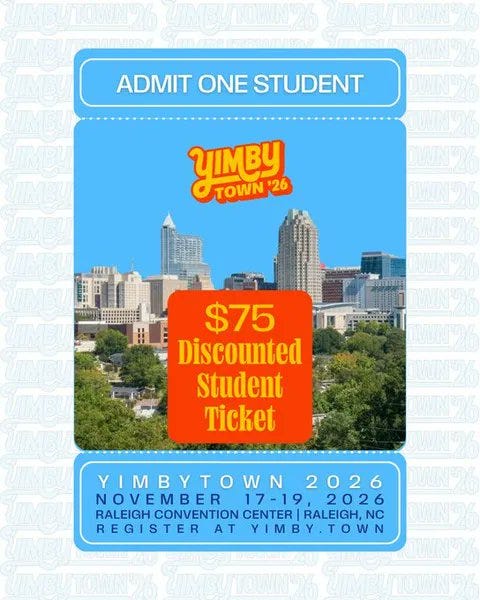
I’m paraphrasing the story, but it’s well documented through her own organizations and books like Golden Gates: The Housing Crisis and a Reckoning for the American Dream. Sonja’s early strategy was documentation and counter-strategy rather than performance. She and others in the Bay Area helped launch the YIMBY movement, now 10+ years old. Later this month (November 17-19, 2026), it takes its flagship YIMBY.town conference eastward to Raleigh-Durham.
I started the @YIMBYDurham Twitter account shortly after, which, to my knowledge, was the first YIMBY account in the South. I did it because I saw absolutely reprehensible behavior in land use meetings that needed to be documented, and deserved to be documented, but, for various reasons within our journalistic institutions, weren’t being documented.
That pattern largely mirrored citizen advocate strategies developed in the Bay Area, which worked primarily because they were so simple. 1) Show up to obscure policy meetings and 2) tweet what people are saying.
After a century of unchallenged anti-housing policymaking, most commentary was beyond absurd. Shockingly often, what was being said was so ridiculous it required no additional commentary. You just had to republish it. Verbatim. More often than not, “not in my backyard” rationales would break under the weight of their own nonsense.
And with this remedial advocacy—simply. publishing. truth.—the YIMBY movement was born.
SOUTHERN FRIED YIMBYISM
Since then, YIMBYism has evolved significantly. It has taken root in different ways across America’s regions. In the Midwest land use regulation is relatively less punitive, but there’s not the growth that there is in the South. The South, now roughly 40% of the country, is both regulatory-light and growing. Two-thirds of the country’s population growth this century has happened in southern states. From a housing, building, development, and YIMBY perspective, the South is where the action is.
This is why I am excited for the YIMBY.town conference to come to North Carolina. This will be the first time that it’s held in the South (if you exclude Texas, which Texans do), and that presents a wealth of opportunities to further the movement.

The biggest opportunity I see is that OG YIMBYism is advocate-led and, at times, seems light on practitioner voices. This is a natural consequence of germinating in California, which has America’s most restrictive planning environment and has squeezed out most incremental development activity (where I think YIMBYism’s principles are most fertile). Different contexts produce different bottlenecks. California’s extreme regulatory environment created one set of problems—primarily a housing shortage —which the West Coast movement has made its biggest priority to address. Other regions face different constraints around growth, design quality, or political capacity. The West Coast movement that launched all of this remains essential; the point is not to dismiss it but to recognize that the constraints look different elsewhere.
The simple principle is that the thicker the rulebook gets, the more corporate, banal, vanilla, and uninspiring your development will be. Even with unprecedented wealth in California, most development is uninspiring, even when built for the ultra-rich. In my view, that’s a consequence of bad land-use policy.
Great design comes when builders have to compete. They don’t have to compete in California, so they're less motivated to do better. But when you look at the South, there are all sorts of examples of innovative builders having to do creative things to create amazing places. Why? Because they have to compete. The vast majority of new urbanist traditional neighborhood developments built in the last 40 years are in the South. Look at the row of developments on Florida’s 30A beaches. As recently as 1980, it was a barren, inhospitable wasteland. But today it is home to four of America's most remarkable new towns: Seaside, Watercolor, Alys Beach, and Rosemary Beach.
And while these are second-home resort communities, plenty of traditional primary-home neighborhoods exist and are worth studying, including Trilith, Serenbe, Glenwood Park, Woodstock, Summerhill, and Vickery. And that’s just in Atlanta.
Despite the inaccurate but often-repeated claim that New Urbanism caters only to upmarket clients, the movement has produced a wealth of innovations in affordable housing, including beautiful, lower-cost, walkable neighborhoods like Newtown St. Charles, Daybreak, and Holiday.
The movement is also closely linked to intentional community development in the mold of Ross Chapin and the late Christopher Alexander, and to innovations in extreme affordability, largely driven by the Incremental Development Alliance (where I am faculty), best conveyed through the work of Eric Kronberg and Allison Quinlan, both of whom have been active in zoning and building code reforms at the most surgical of levels.
New Urbanism and YIMBYism are two sides of the same coin. Both reform movements will take off when leaders realize they have more in common than they differ.
YIMBYism + NEW URBANISM CAN (AND MUST) ALIGN
The common denominator of all of these great developments is that none of them were legal. And that’s an incredible black mark on those who create these rules (particularly America’s planning consultants). If you put yourself in a room with sincere people about what sustainability looks like, what placemaking means, and how we build places that matter, you’re going to end up with something that looks like New Urbanism: product and cost diversity, walkable communities, access to restaurants and retail, deprioritization of the car, amenity spaces and parks, etc. etc. But none of this is legal to build, by right.
And that’s the problem. Many YIMBY activists, particularly those under 40, don’t realize that their existential motivation is nearly identical to that of the founders of New Urbanism in the 1980s. In the early 1980s, young Yale architecture graduates Andres Duany and Liz Plater-Zyberk offered a full-throated objection to mindless, corporate, centrally planned sprawl and declared they would dedicate their lives to stopping it.

Then they did. They opened their own practice and have spent nearly half a century building a movement, training these principles into a small army of designers, builders, developers, and policy officials determined to build better cities. Its offshoots include the Incremental Development Alliance, The National Townbuilders Association, The Urban Design Guild, Strong Towns, and Southern Urbanism (among others). All of which are fundamentally aligned with the core motivation of today’s YIMBY movement.

There is a generational divide here, for sure, but I wholeheartedly believe that New Urbanism and YIMBYism are two sides of the same coin. Both reform movements will take off when leaders realize they have more in common than they differ.
The yin and yang have always been obvious to me, but nearly everybody else I talk to has missed them. YIMBYism and New Urbanism each have strengths and weaknesses that nearly mirror each other, creating a whole greater than the sum of its parts.
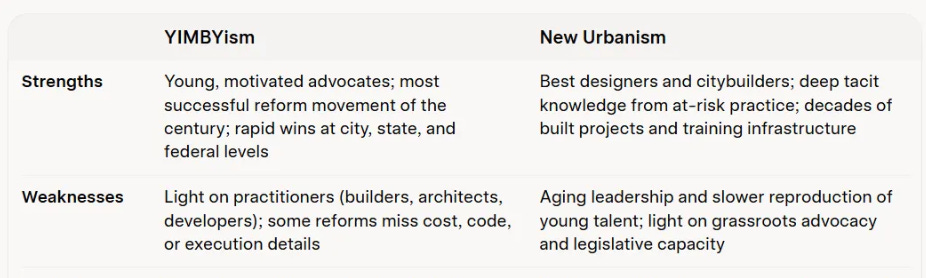
New urbanists are the best designers and citybuilders in the world, but concerns remain about aging out and failing to reproduce young talent. The movement isn’t growing as fast, and it’s heavy on successful practitioners and less on advocates, so they are less motivated to do the tireless grassroots advocacy to permanently change code in city halls and state legislatures. The YIMBYs are the near-exact opposite: probably the most successful reform advocacy movement in America this century, it’s young, motivated, and racking up reform successes at every level of government. The main critique of the YIMBY movement is that it lacks practitioners—Builders, Architects, and Developers (facetiously “The B.A.D. Guys”)—which means its ability to execute ultimately relies on others to act and is inherently hampered. Also, without the tacit knowledge only experienced at-risk practitioners have, some YIMBY reforms can miss the mark, even slightly. I’ve seen faith-based housing legislation (CA, among others) that requires a level of affordability that makes it pretty much non-viable. I’ve seen triplex legislation (MN) that failed to address form-compliance issues and building-code cost thresholds, rendering it mostly toothless. These are easy fixes, but how?
Simply put, advocates need to become practitioners, and practitioners need to become advocates.
THE GREAT CROSSOVER
All of these challenges are okay, of course, and natural consequences of growth. With the YIMBY movement’s rapid success, demand keeps growing to do more, and do better.
For me, no next step is more important than helping leaders (particularly young leaders) in both movements participate in what I call “The Great Crossover.” Simply put, advocates need to become practitioners, and practitioners need to become advocates. We need more architects and builders to share their solutions with policymakers. And we need more YIMBYs to build housing. And I’ll know YIMBUrbanism (?, I’ll work on that) is truly flourishing when:
Local builders regularly engage politicians at the city and state level to advocate for the reforms needed to build better places.
Sonja Trauss builds her own duplex (or equivalent).
Universities modify design/development/policy class offerings to expressly develop this new YIMBY-Builder superbreed.
And I hope this Great Crossover will be a topic of discussion at the forthcoming YIMBYtown conference. For most, building a home seems like this dark art that most humans couldn’t possibly do. But that’s not the case, and we teach it regularly at the Incremental Development Alliance (and it’s a big part of community colleges). Whether you have carpentry skills or don’t know which end of a hammer to hold, most Americans can buy land, license a house plan, get a loan, and build a home. It might be a $3 million home at I’On, or a tiny home built for $100,000 in Durham by someone like Topher Thomas of Coram Houses.
Homebuilding is actually quite simple even if it’s not easy. It’s hard work. Your back hurts. Bad weather or missed details can cost you thousands of dollars. The neighbor might threaten to kill you for installing a sewer tap. You have to navigate Byzantine systems. You’ll deal with bureaucrats—some of whom are wonderful and some who have hate for the world. Such obstacles may prove trivial for someone with the persistence to get a major housing reform through the California State Legislature. But if you build a home for yourself, or your family, or community, you’ll become a better person through the process. And you’ll become better at whatever your profession is—whether that has something to do with building more housing or you are a teacher or a bartender, or a laborer.
The Great Crossover, should it occur, will usher in an era of new Renaissance men and women. People of skill, curiosity, charity, and love for their community. People who want to leave a legacy for their family and fellow man. Who are willing to sacrifice something to realize a better future for humanity.
That’s why YIMBYism matters.
Hope to see you all in Raleigh.
Aaron Lubeck is a designer & builder with The Rocket Shop in Durham. He is the author of Green Restorations: Sustainable Building and Historic Homes and a former adjunct at Duke University’s Nicholas School, where he taught sustainable home building. Aaron is a founding faculty member with Incremental Development Alliance and was the original host of The Townbuilder’s Podcast, a curated conversation with top new urbanist developers. He writes about policy reform, urbanism, and incremental development at onHousing.
CAPACITY IS LIMITED | BUY TICKETS TODAY