


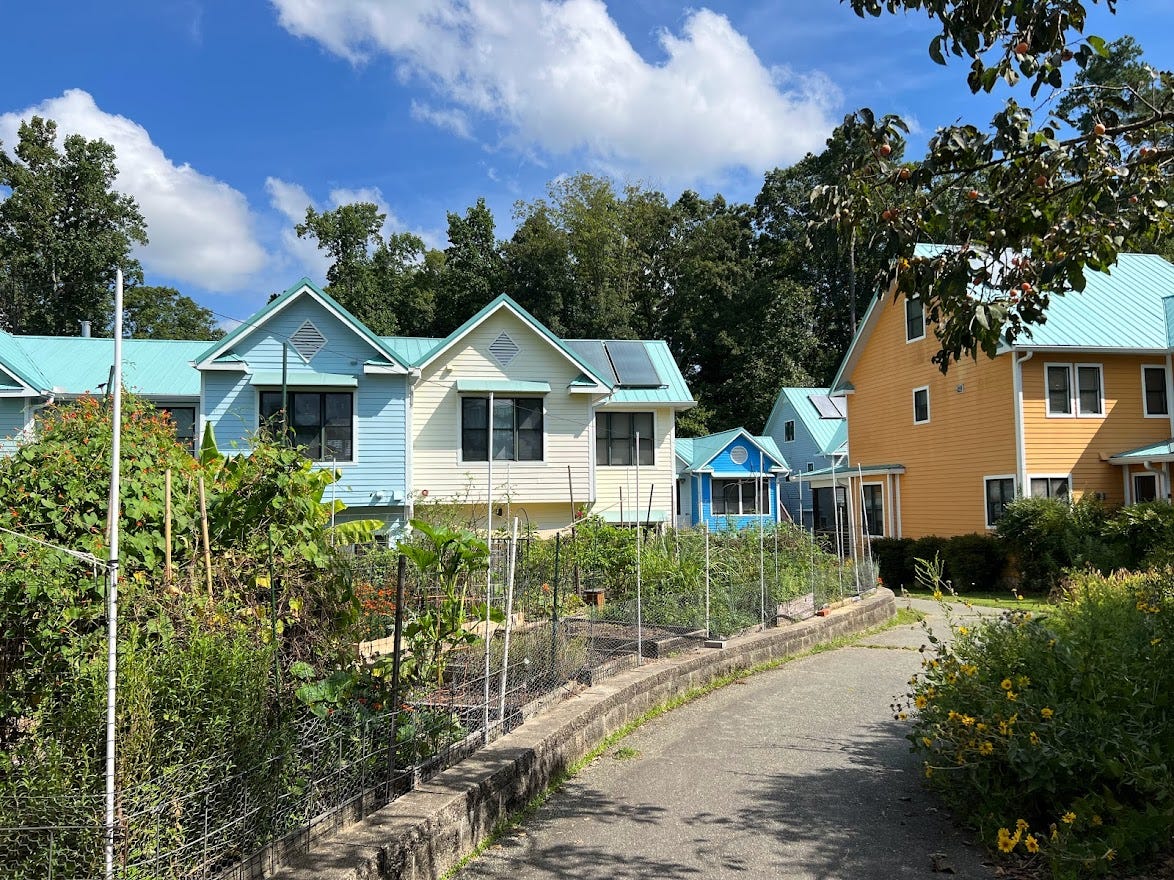
I have been walking through Pacifica periodically for 20 years now. It’s nestled a stone’s throw from downtown Carrboro, right next to the Wilson Park baseball fields, where I stroked home runs over the fence as an inexplicably oversized 12-year-old.
To the outsider, Pacifica looks like any other mid-market townhome project. But it is not.
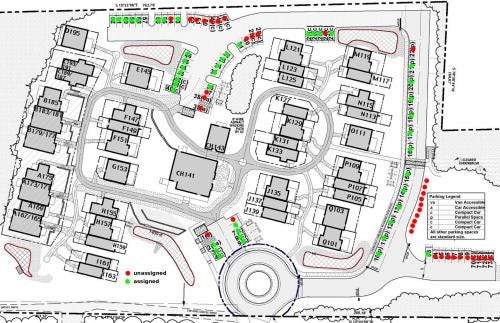
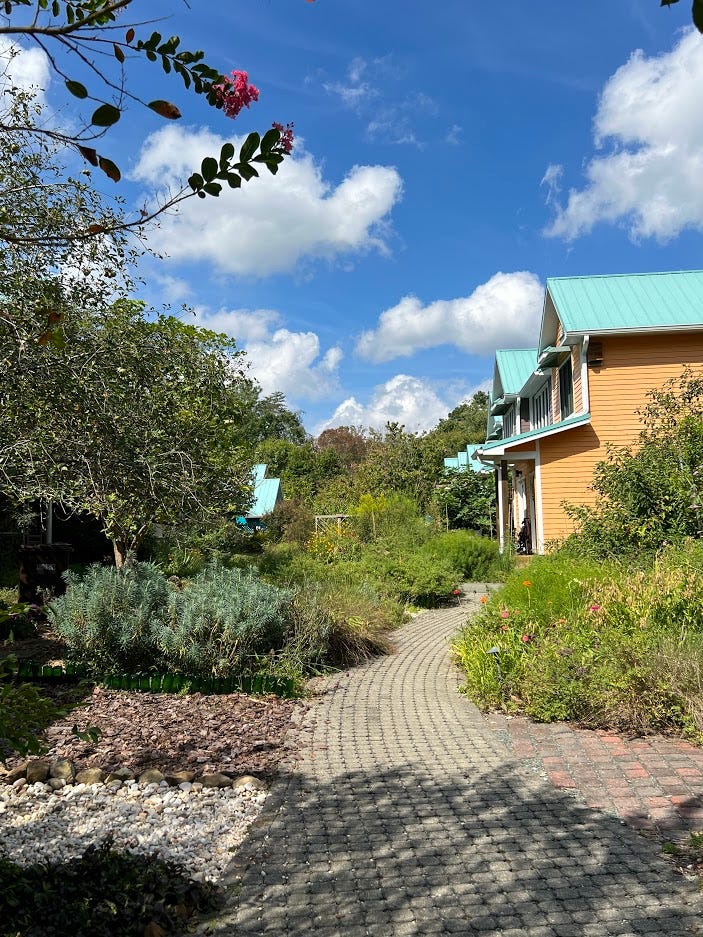
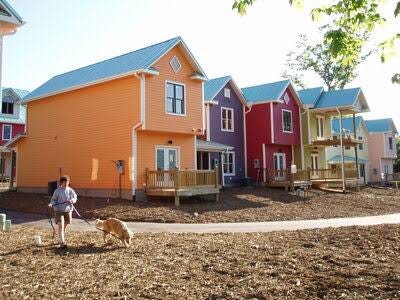
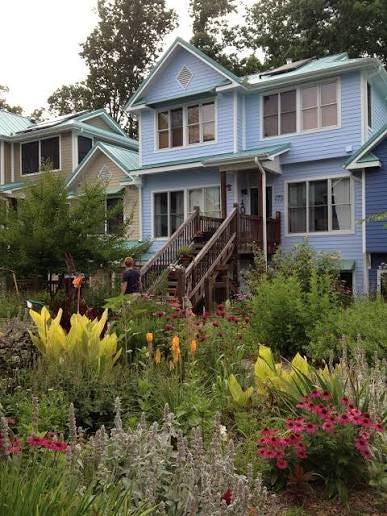
Built in 2006 and designed by the recently departed Giles Blunden—who was already living at Arcadia cohousing down the road—it houses about 100 people in 46 homes on eight acres. What sets it apart from traditional development are common gardens, cisterns, a guest house, laundry, and a large commons building. Parking is isolated at the edge. The walking paths are for people to engage, garden, and wander.
You would let a four-year-old roam freely here. It just feels cozy and safe.
I’m still on Pacifica’s email list. Last week, a post about an available unit arrived (below), which finally bumped this piece I’ve been meaning to write. You can see how the project is attractive to people living in Carrboro, adjacent to Chapel Hill and UNC.
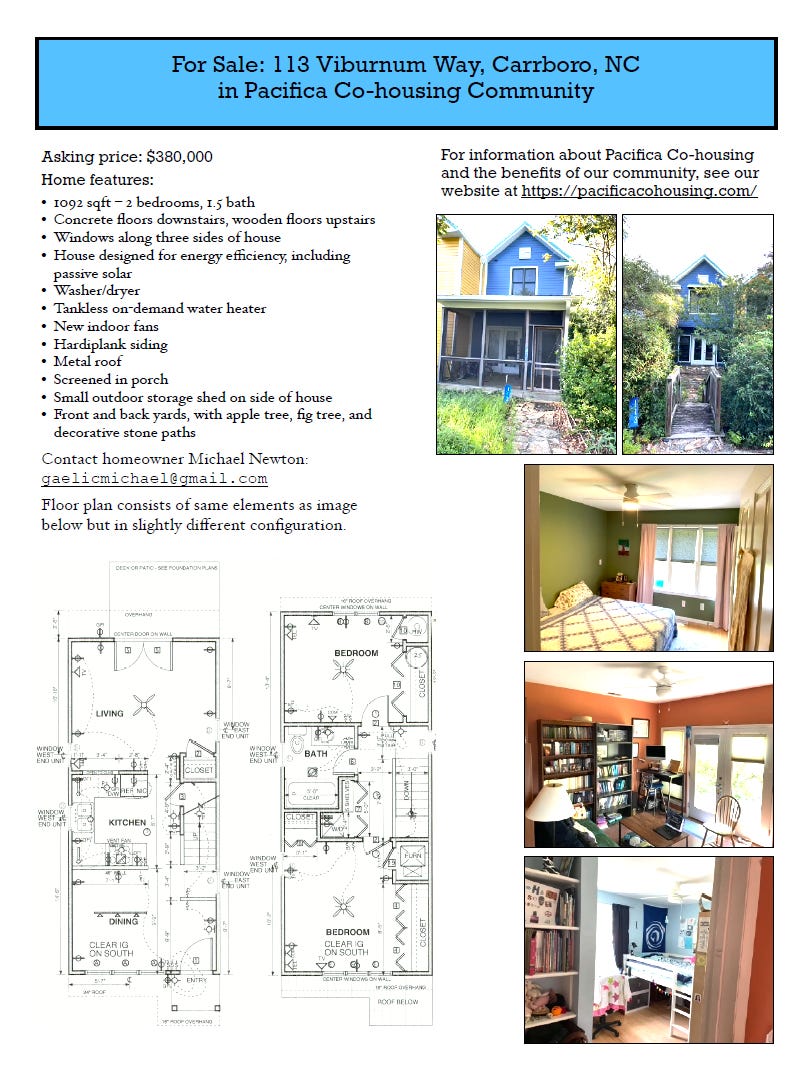
Pacifica got right what many cohousing communities did not. For what you get, it is astonishingly affordable. That goal is only achievable today through cheap dirt, more density, and smaller homes. Pacifica does (/did) all three.
Done well, shared amenities raise quality of life while lowering cost of living. That is the core offering of cohousing.
Cohousing adds a fourth tool for affordability: shared amenities. A guest house lets people live smaller. Shared laundry and garden tools mean not every household needs a lawnmower, weed whacker, and hedge trimmer. Seven of the units are owned by a community land trust, which helps maintain a price ladder. Residences run from about 600 to 1,460 square feet. Some residents might want larger, but the small sizes keep the community within reach of Carrboro’s many young families, graduate students, and seniors.
Done well, shared amenities raise quality of life while lowering cost of living. That is the core offering of cohousing. It’s also the core offering of urbanism.
At Pacifica, the community collaboratively manages shared space, and residents are expected to put in hours. From their own site:
It takes time to keep the community running. Although no set level of participation is mandatory, we encourage all to attend monthly meetings and join at least one committee. Each household is asked to contribute a set number of community labor hours each month, either during shared workdays, committee work, or at their convenience. Households that do not complete these hours of community labor monthly are assessed a fee for each hour of missing community labor in addition to HOA dues.
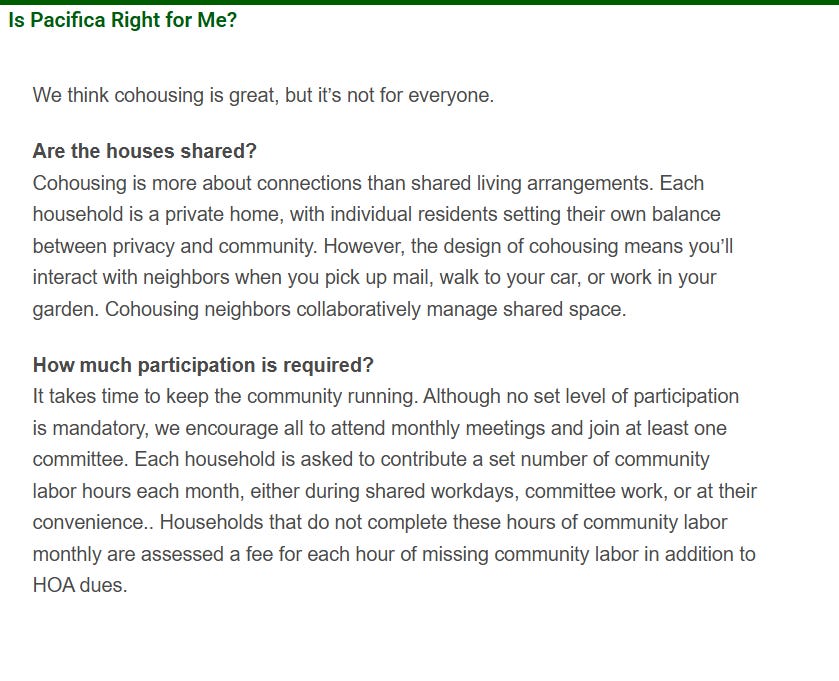
The set number is apparently four hours a month. This differs from traditional development, where you pay a fee and some outside landscaper is paid to tend perfectly mediocre greenery. Pacifica’s outdoor spaces are more special because the people who live there curate them. Edible gardens are plentiful. You get the feeling that hundreds, perhaps thousands, of meals come from bounty grown on site. There is no quantitative data point for that.
Cohousing is Not a Co-op
Often treated as synonyms, cohousing and co-ops are different things. Cohousing is a way of living. A co-op is a legal ownership structure. Both can exist in the same project, but don’t have to.
Pacifica is not a co-op. Homes are owned fee simple, in a traditional HOA format: owners privately own their land and improvements. The HOA then sets operational rules for maintenance and access to amenities.
A co-op is a corporation that jointly owns the buildings and land. People buy shares in that corporation, which gives exclusive rights to occupy a unit. There is no deed. Governance is typically democratic among the shareholders, subject to an operating agreement that can function like community Covenants, Conditions, and Restrictions (“CC&Rs”) for an HOA.
Neither is wrong. I believe that zoning should be flexible enough to let developers and residents decide which is best for them. I personally am skeptical of any ownership model that isn’t fee simple, and I would avoid general cooperatives where boards can dictate things that affect my private life. I’m also concerned that there is less case law in a place like North Carolina, which adds risk to the model.
In fairness, boards exist in both. But the co-op board does not offer the protection of fee-simple title. Co-ops also create more lawsuits: board rejection of a buyer; “objectionable conduct” evictions; claims the board breached fiduciary duty or acted in bad faith; share transfers, flip taxes, sublet rules, and who lives in the unit.
New York City alone has thousands of co-op buildings and a specialized bar, trade press, and docket for this. Lawsuits lasting a decade are not unheard of. Limited-equity and HDFC co-ops add another layer: alleged insider deals, residency-rule violations, and oppression claims. All of that is a red flag for me about co-ops, while I remain enthusiastic about co-housing.
Why We Don’t See More Co-housing
Co-housing is not for everyone. Many, if not most, would be put off by the structural obligations of maintaining a community commons. That’s fine. But demand clearly exists for more intentional communities like these, and a stack of structural reasons keeps us from seeing more of them.
The main reason, in my view, is that top-down planning—which is at its worst in intellectual communities—overthinks zoning to the point that these projects rarely come to fruition. In other words, co-housing developments are artificially suppressed.
I have personally witnessed ambitious developers face silly demands such as these:
1. the parking has to be on the same lot as the house;
2. houses must front a street;
3. every unit must have its own dedicated private yard.
And when a developer objects to these requirements and points out how they make a community worse, such objections generate a robotic-like answer: “Them’s the rules, them’s the rules, them’s the rules.”
Projects are worse as a consequence. If they happen at all.
We need to let less bullheaded property owners build great places, too.
The developer can exhaust themselves arguing that “there’s plenty of parking.” “It’s ganged to the outside.” “Our residents want to face a green more than a street.” or “The community prefers better shared space to mediocre private space.” Doesn’t matter.
And there is another often misunderstood pressure point. While the developer is at risk, on various clocks and making no income during pre-occupancy phases, the planning machine she is up against carries no risk, has no clock, and is programmed with an army of less-motivated overseers who are all on salaries. No reasonable person will fight this machine for long.
That’s why co-housing, and any intentional community, is often led by an unreasonable person. That’s not to say they are bad, or even unfair; they are just stubborn and determined. If they are not, they’d never get these projects off the ground.
The best projects in urbanism are disproportionately led by bullheaded developers who won’t take a nonsensical, robotic “no” for an answer. This is one reason planning reform matters: we need to let less bullheaded property owners build great places, too.
Lessons moving forward
I hope to see more co-housing communities, and intentional communities of all types. I believe the Triangle, with its high concentration of creative-class types and outlier identities, is the perfect place for this kind of development, and policymakers should move swiftly to allow these communities to flourish.
Here are a few lessons to carry forward:
1. Durham, Carrboro, and Chapel Hill have gotten an incredible number of land-use things wrong in the last 50 years. They are also home to some extraordinary cohousing projects: Arcadia and Spring Glen, Bull City Commons, Durham Central Park Cohousing, Eno Commons, Solterra, Village Hearth, and Weaving Water. (Elderberry, often grouped with this list, sits in Rougemont, but is excellent.) I have encouraged political leaders and housing activists to acknowledge these successes and double down. Let’s ask ourselves, “What would our cities look like if there were 50 of these communities? Or 100?”
2. Ask developers what is preventing more of these from being built. Cohousing is just one form of intentional community. Arcadia and Pacifica are the tip of the iceberg. The problems that show up when you try to design these places generally relate to punitive utility requirements (a development guidelines problem), or parking regulations and the inability to sell lots fee simple (planning problems).
Beyond that, a fledgling science exists for managing cohousing communities that have to deal with what Ross Chapin would call “the software”—the rules that govern the society, as opposed to the architecture, which is “the hardware”. These are more of a legal problem. As we see more opportunities for micro-communities as small as three to five homes, we also need scalable, simple software platforms to manage them. Sometimes that software will dictate where people park. Sometimes it will articulate volunteer hours, quarterly barbecues, or what happens if the sewer backs up.
3. Lastly, we will need new financing products for both for-rent cohousing and for-sale communities. One of the least appreciated consequences of the Great Financial Crisis of 2008 was how narrow and conservative banks got with their lending. If you want to land on anything other than large apartment complexes or conventional single-family subdivisions, you run into a lot of stop signs. Before 2008, more lending was local. We will need new products, and I suspect those products will come from local lending again. This is an extraordinary opportunity for local banks to separate themselves from the herd. Often they won’t get interested until there’s a critical mass. We’re stuck in the awkward space where we need cohousing communities to justify lending products, and lending products to create cohousing communities.
Like all things, we’ll get there. Right now, great placemaking requires determined leaders’ intent on bringing these places to life, against the machine—and against a system that seeks to prohibit them in almost every way.
Shared amenity is not a lifestyle brand. It is how cities work when they work. Pacifica has been proving that on eight acres next to a ballfield for twenty years. The listing in my inbox is not the story. The fact that we still treat community as a novelty is.

