


ATLANTA, GEORGIA | I was out in Santa Fe this fall for the National Town Builders Association’s biannual conference. The gathering focused on how to honor and continue the deep traditions and history of a place while also not stifling what makes that place great. I’ll write more about other sessions in the coming weeks. The most impactful presentation I saw, though, articulated a more universal principle: one I call True Affordability™.
True Affordability™ has a simple definition: it is housing that is built inexpensively and then rented or sold inexpensively.
I trademark the term jokingly because the word “affordability” is so tainted—beyond repair in my view—that practitioners like Eric Kronberg generally avoid using it now. They opt instead for less spoiled language such as “attainable” and “workforce housing.”
True Affordability has a simple definition: it is housing that is built inexpensively and then rented or sold inexpensively.
Secondarily, it is generally unsubsidized, unpoliticized, and almost always built by people taking real personal risk. Conventional “affordability” (or Capital-A Affordable Housing), by contrast, meets none of these criteria. It tends to involve complex projects built expensively, coupled with massive subsidies, and developed by people who rarely, if ever, take risks. The result is the many cases of outrageous costs associated with these projects. At most five percent of the conversation about affordability addresses True Affordability, and it bothers me how many professionals remain incurious about the primary problem: lowering the cost of housing.

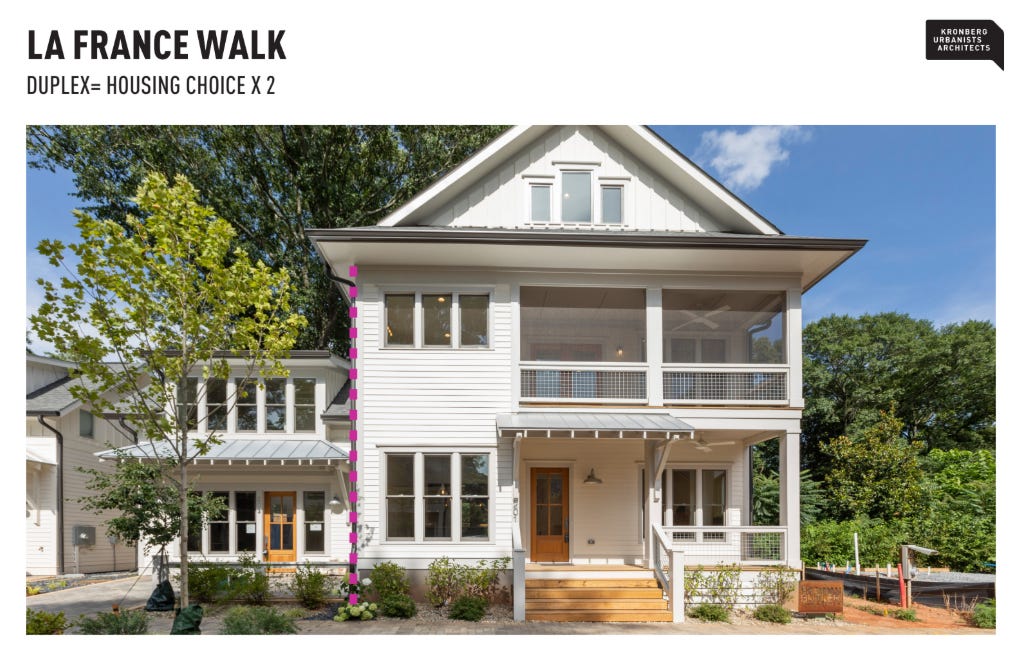
In his excellent La France Walk project in Edgewood, Atlanta, Kronberg developed a series of small units that achieved True Affordability on multiple levels. First, many homes have a separate bedroom suite, generally about 200 square feet, essentially a small hotel room with a kitchenette and full bath. These can be rented to an extended family member, used as an office, or rented out to help young couples pay their mortgage.
But the more interesting long-term principle achieved here was how he created simple small homes that were both affordable and wildly popular. The project, roughly 25 units on 2.5 acres near a rail station, mixes small single-family homes, duplexes, and attached suites while minimizing parking in favor of walkability. It earned a CNU Charter Award and an Atlanta Regional Commission Development of Excellence award.
