


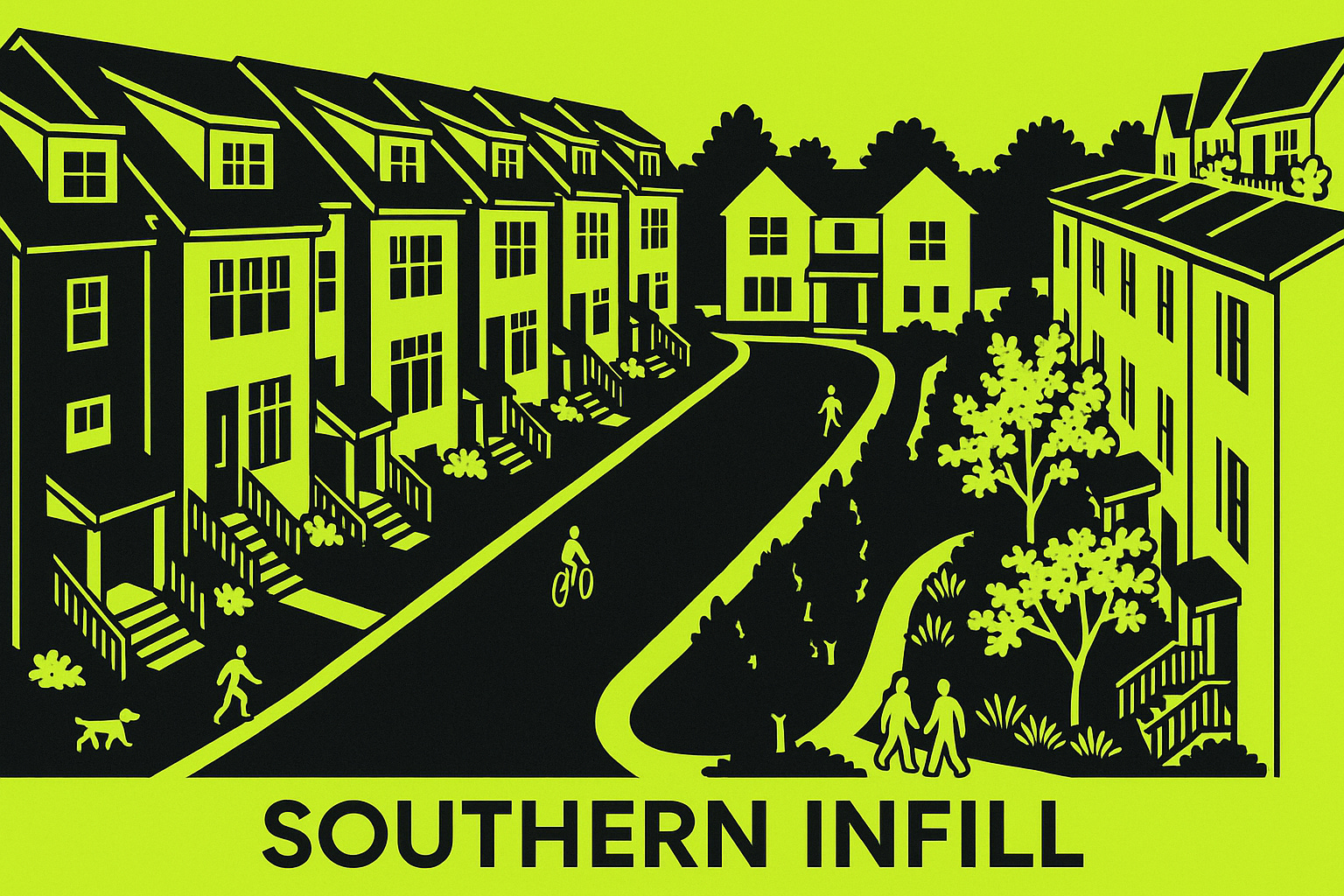
The American South has spent the past decade undergoing a quiet but remarkable cultural shift: a home attached to your neighbour is no longer a sign of low income. Until recently, townhomes and multifamily were the exclusive domain of less affluent residents, but they have rapidly become desirable to mid-market (and increasingly high-end) buyers. That’s what is happening with urban townhomes in Durham.
Let’s talk about why.
As someone who designs small infill projects for a living, I sit squarely at the intersection of land scarcity, zoning obstruction, political theatre, and the ruthless economics of new construction. So when a new project appears in my own backyard, it’s an excuse to think out loud about what works. So let’s deep dive into Elm Hill.
ELM HILL
Elm Hill is a proposed 68-unit infill townhome project at 518 Morehead Avenue, a few blocks from downtown Durham. Developed by Alchemy Properties, the homes are large by urban standards—1,900 to 2,400 square feet—with basements that can function as flexible accessory spaces, plus roof terraces and a small package of amenities: a clubhouse, co-working space, gym, yoga studio, and dog run. Prices start at $875,000 and rise accordingly. For a site next to American Tobacco, DPAC, and the Durham Bulls, none of this surprises me.
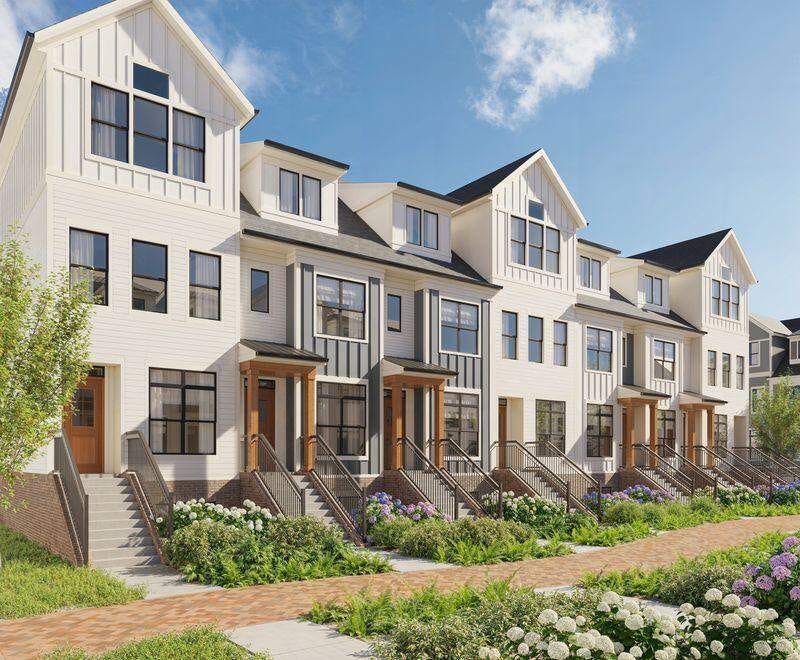
Predictably, these price points invite the ritualised complaint: but it isn’t affordable! It’s true. And yet, that framing misses the actual trade-off on land this valuable. A buildable pad in this district may cost $300,000 (or more) before a single nail is driven. There is no mathematically coherent path to a $300,000 home here—unless the city subsidies are massive or the product is extremely small.
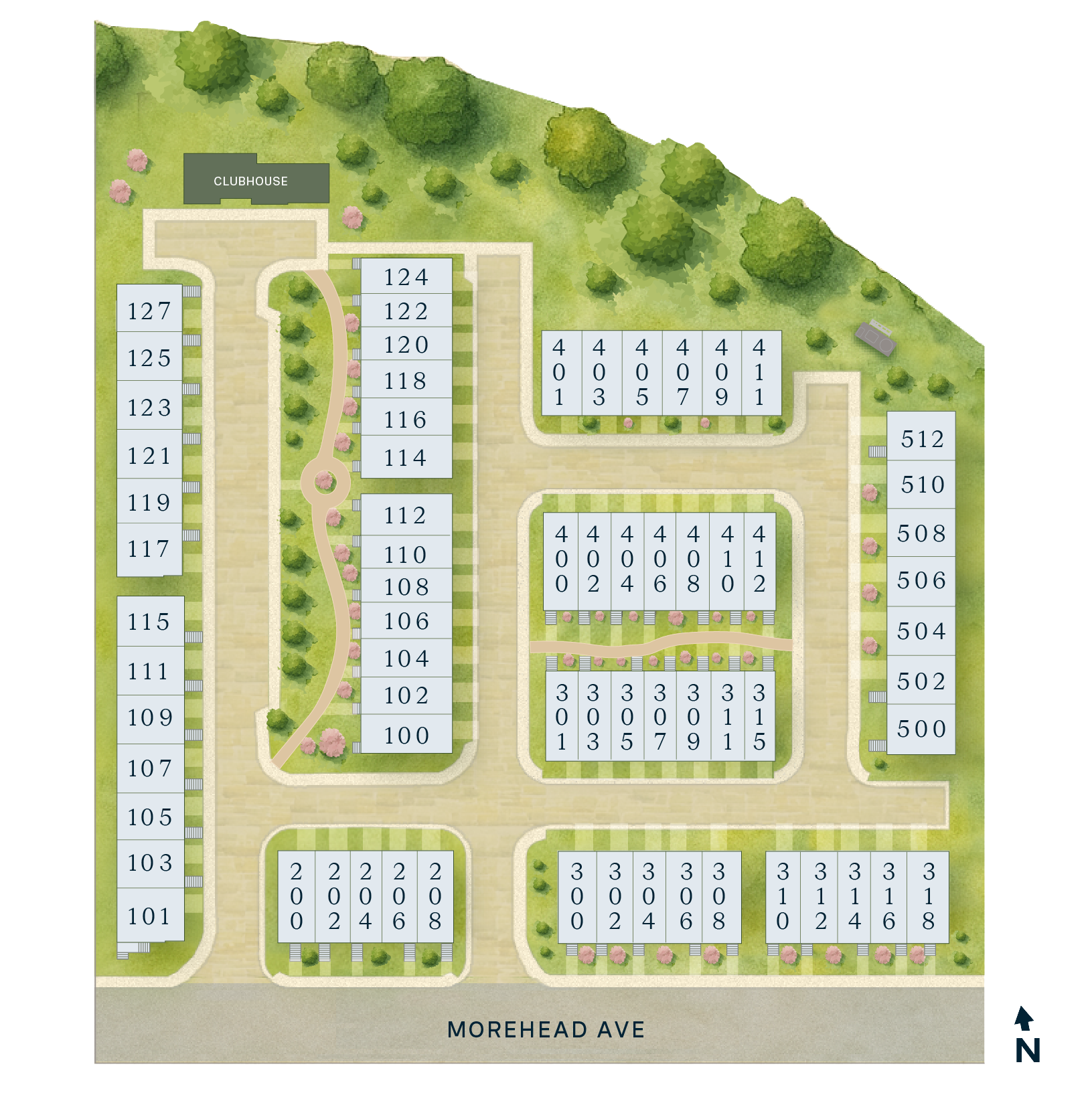
In that context, Elm Hill is serving the households who, absent new supply, would outbid long-time residents in the surrounding (often affordable) neighbourhoods or occupy historic homes that should otherwise remain relatively stable. Mews-scale density—intimate, neighbourly, but still urban—is a far more responsible outcome than pretending growth economics don’t exist.
WHY LONDON’s MUSES ARE HARD TO DO
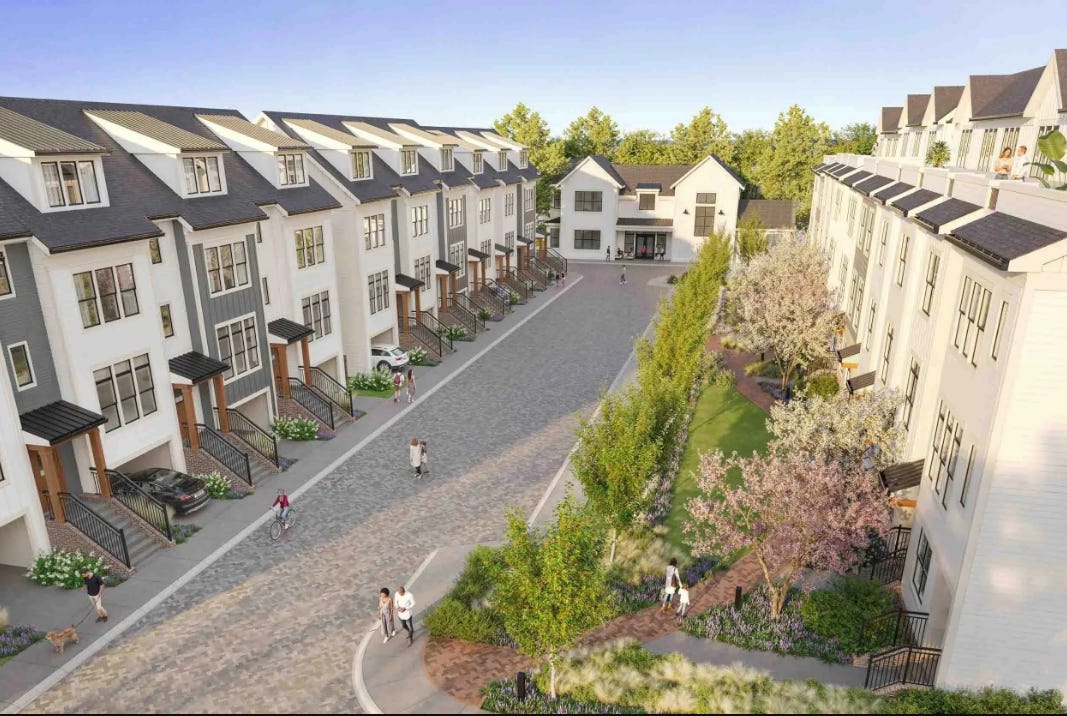
One of the harder challenges in townhome design is reconciling density with open space and circulation. Elm Hill solves it better than most. Cars disappear into tuck-under garages, preserving the centre of the site for people rather than parking lots. While the central lanes are technically drive aisles, they have the bones of a true London mews—a form that American developers almost always botch.
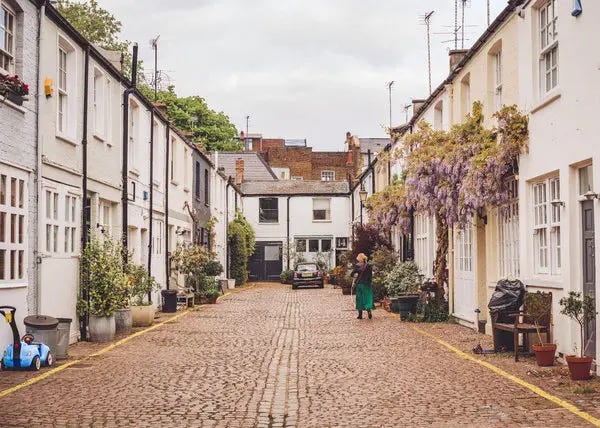
The recipe is straightforward but rarely followed: no double-wide garage doors, real greenery (often in container pots due to limited space), good lighting (stringed Edison bulbs work great), and paving materials that make the drivelane feel more like a patio than a public street. Pavers or stamped concrete can transform what is normally a car sewer into something resembling a London lane.
The renderings at Elm Hill suggest that Alchemy at least understands this opportunity.
GARDENS IN THE SKY…
The shift of usable outdoor space from ground level to rooftop decks is another trend that’s rapidly becoming standard in southern urban infill. The trade-offs are real, and there are aspects of the trend I do not love. Private outdoor rooms can offer great views, but provide almost no semi-public space for the casual neighbour contact that many of us believe is integral to urbanism.
Without front porches, southern cities lose some of their social electricity. The “gardens in the sky” may be pleasant, but they are unlikely to replicate the unplanned interactions of stoops and porches that are, in my view, integral and defining characteristics of traditional southern life.
And at four stories, these buildings will require sprinklers—perfectly sensible at this price point, though a cost factor that keeps similar formats out of the entry-level market.
…& BOARDERS IN THE BASEMENT
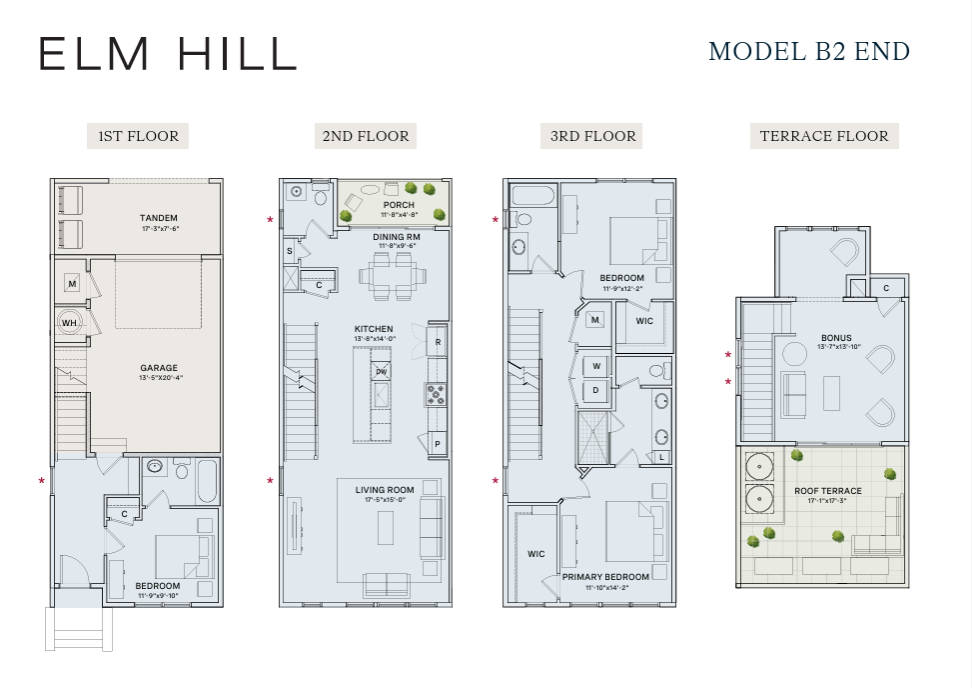
One design move I genuinely appreciate is the inclusion of basement-level flex units. Unbeknownst to most, Durham is one of the few municipalities in the country that allows ADUs on townhomes. These spaces can (and will) become accessory dwellings or small offices. Durham needs this badly. Every increment of gentle density like this helps (it effectively doubles unit density), and ADU-capable formats are one of the most fiscally and socially productive things we can build near downtown.
In the end, Elm Hill is a strong project. The architecture is competent, the density is neighbour-scaled, and the public realm isn’t treated as an afterthought. Some developers have reported softness in the townhome market this year, and it’s true that a few urban townhome projects are sitting longer than expected. These, I suspect, will still absorb—Durham remains in a structural housing shortage, and its population is on track to nearly double by mid-century. The real gap is not whether Elm Hill should exist, but how many more versions of this we can build with smaller footprints and more attainable pricing.
For now, as infill goes, Elm Hill is a step in the right direction—and a reminder that mews-style townhomes, done properly, offer a middle path between towers and sprawl. That’s exactly what Durham needs far more of.

Additional reading: Durham urban infill continues with new ‘townhome-style’ condos starting at $875K (link)
All of this is to say it is really hard to improve upon the typology of the classic Baltimore rowhouse in its many styles, and the rear alley. The best of the modern rowhouses being built in Baltimore today retain the rear loaded garage or parking pad and are quasi-industrial in style. Generally no porch, but at least retain a sittable front stoop. (The worst look like suburban “townhouses” with front loaded garages plunked down in the midst of the city). You are right, the four story version is expensive ($600-800,000), partially due to land cost in the areas where new building happens. If you skip the integrated garage, is there a reason why a 3 story version cant work just as well for less?
If the economics support it, what’s wrong with towers?