


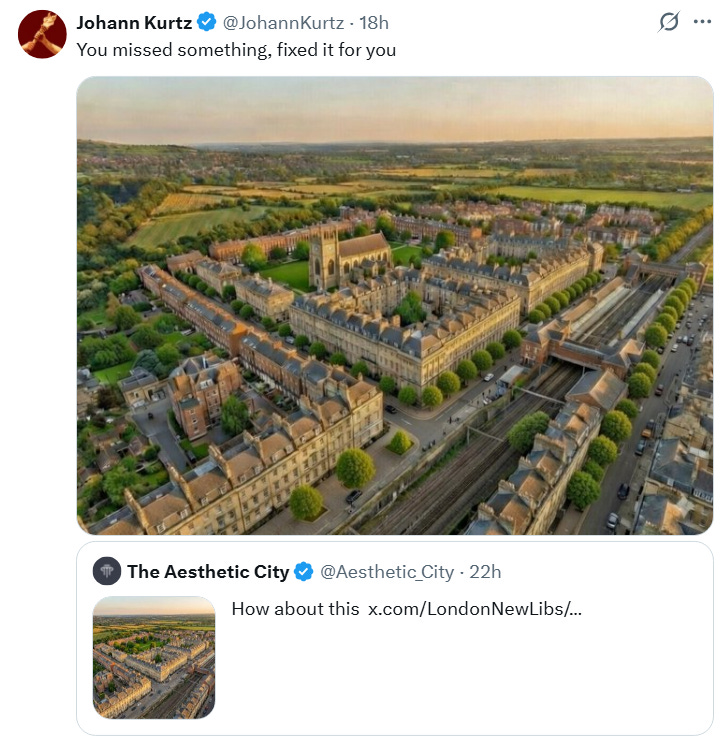
I got a chuckle out of the below AI development Twitter exchange last week.
Through the magic (/curse) of artificial intelligence, housing advocates are putting forth personal visions for the kinds of communities they want. One of the leaders here is Alicia Pederson, the Courtyard Urbanist, who has created a groundswell of support for building urban courtyard blocks with 3-6 story buildings surrounding a private or semi-private green. She has unleashed a cadre of people around the world, seeking to explore how their communities can be improved through the concept of courtyard housing. In this spirit, London New Liberals took a greenfield site and proposed what it could look like with new buildings built around courtyards. Then Ruben Hanssen, of The Aesthetic City, took his hack at making it better.
Johan Kurtz closed the loop by putting a church in the Ruben’s image, with his thesis implying (by my reading) that shared values 1) expand the size of the community in which we want to live, and 2) are critical to successfully pulling off these larger courtyard-type projects.
This is accelerated iteration in the modern age.
4 EVOLUTIONS
The full 4 evolutions are here:


THE HUMANS BEHIND COURTYARD PLACEMAKING
I had the honor of grabbing breakfast with Alicia last time I was in Chicago. She is professionalizing her advocacy, and I think she is a rising star in both the urbanist and abundance circles. I know Ruben from being a guest on his podcast, and I hope to attend his summer school in the coming years.
I do not know the others, but I am delighted to witness how people from different corners of the globe can collaborate to iterate better placemaking. The internet mostly sucks, but this is the kind of exchange we hope to have in the rare moments it functions as it was meant to.
I could live in any of the three iterations, which are hands down better than what we build today throughout the American South.
I want to talk about one issue this process brought up for me, related to Ross Chapin’s Scale of Sociability.
SCALE OF SOCIALBILITY
Ross is the semi-famous author of the book Pocket Neighborhoods. In it, he defines the Scale of Sociability as the natural, small-group size at which humans most comfortably and effortlessly connect, interact, and build community. Typically, the scale operates best at around 6-10 households built in small clusters, sharing some sort of amenity. This group size fosters spontaneous interactions and encounters, without overwhelming its occupants.
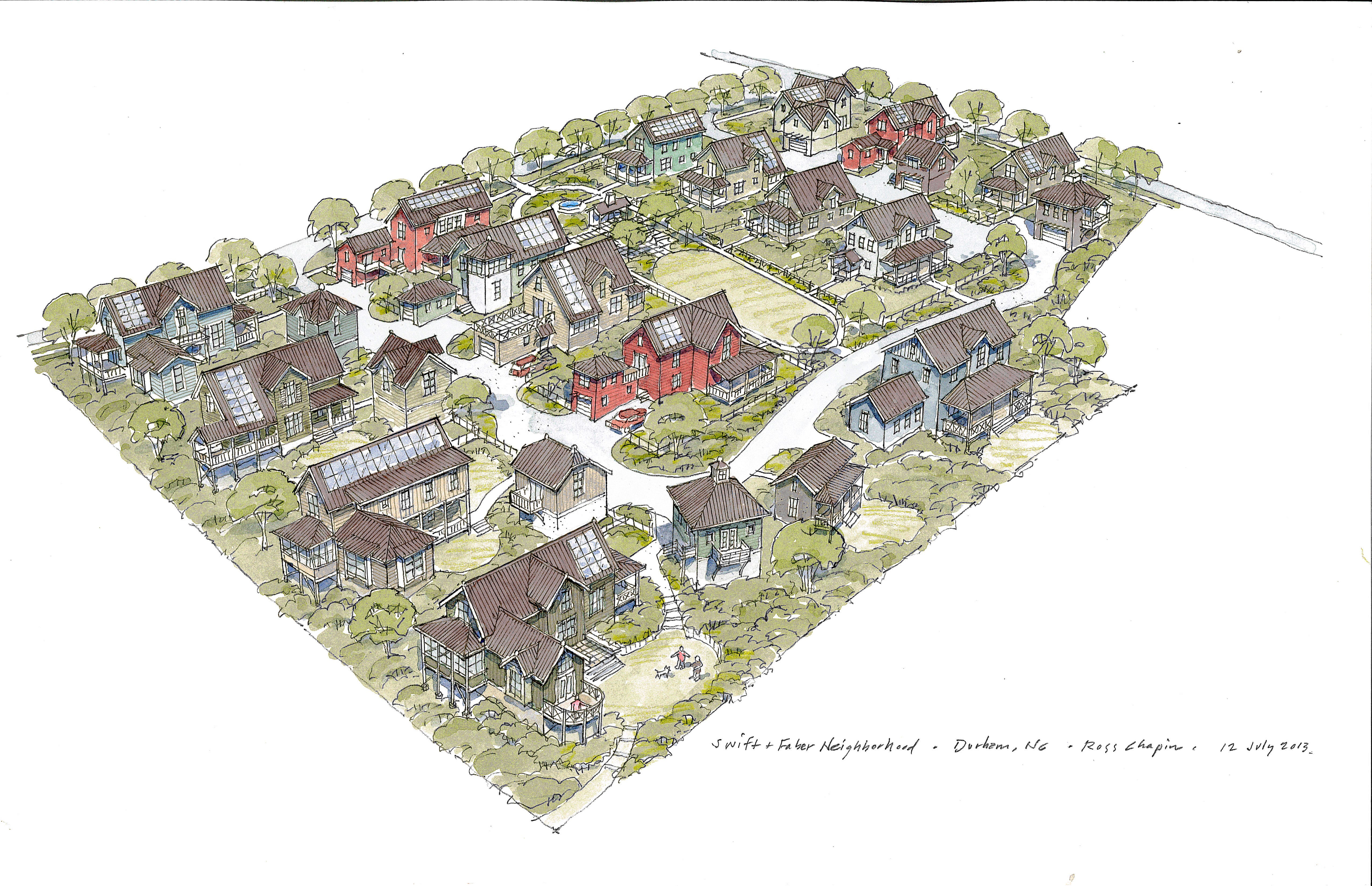
If you know Ross’s developments, they are all clearly designed around this core principle. I have gotten to know Ross through the Congress for the New Urbanism, the Incremental Development Alliance, and through my work designing homes with Duke and the Faith-Based Housing Initiative. Just this Fall, Ross and I discussed whether and how these principles scale to other forms, such as missing middle housing or even urban high-rises.
Despite the Eixample’s extraordinary efficiency, amalgamation effects, distributed ownership, support for storefront retail, and world-class architecture, there is one glaring critique: the courtyards just aren’t used that much.
Ross pointed out that you can still develop a scale of 6-10 households in a mid (or high) rise, it’s just that the shared amenity space might not be at ground level. And while theoretically possible, there are limited examples of this in the US. Instead, as things get bigger, they mostly lose their social scale.

Take a single-stair building for example. A single-stair midrise typically houses up to 24 homes (6 floors, 4 per floor), a scale beyond Ross’ definition of the Scale of Sociability. Now, such a building could be divided into two or three clusters (even vertically), with common spaces on floors 1, 3, and 6, including a common kitchen, music room, and rooftop garden, each with primary use rights for the smaller cluster of homes adjacent to it. That certainly is more complex than doing it at ground level with detached houses. It’s yet to be proven if the concept works as buildings grow towards the sky.
THE CHALLENGE WITH COURTYARD HOUSING
I love courtyard housing, in all its forms. Anyone who follows me knows that I have a small obsession with Barcelona’s Eixample, and the near-perfect urbanism that it creates. (The frickin thing was platted in 1857, which blows my mind.)
Despite the Eixample’s extraordinary efficiency, amalgamation effects, distributed ownership, support for storefront retail, and world-class architecture, there is one glaring critique: the courtyards just aren’t used that much. Most are relatively dead. Which feels shocking when you consider the Eixample is one of the densest neighborhoods in the developed world, at around 100,000 people per square mile.
Wouldn’t a dozen or so of these people, at any given time, want to use the courtyards to live their lives?
What's the problem? What isn’t working?

SCALE MATTERS
I suspect the issue with the Eixamples is that the courtyards are too big and lack community privacy, so they are not very comfortable to be in. I fear, for Alicia’s sake, that Ross’s scale might be the Achilles heel of Courtyard Urbanism. Certainly, future courtyards can and will be better programmed than those in Barcelona. Much has changed in the 175 years since Spain’s Isabelline Era, and there may be new, more effective ways to activate such spaces.

But it may also be true that having more than 10-12 households in a space just makes it feel uncontrolled and uncomfortable. Alicia’s larger courtyards may need to be divided into smaller spaces, such as small-block courtyard housing seen in CuldeSac or Los Angeles. While these smaller spaces lack development scale—and would make your institutional investor throw up in his mouth a little—they do deliver human scale.
Can that human scale be enlarged? I suspect it can, if the occupants have some commonality.
Much of my work now focuses on developing intentional micro-communities, which, as Nabeel Hamdi describes in his book Small Change, can be Communities of Culture, Communities of Place, Communities of Practice, Communities of Hobby, or Communities of Resistance.
Whether you live in a community of Lutherans, Serbians, Podcasters, Hobby Musicians, or Revolutionaries, it holds that the more you share common values and life practices, the larger your circle of trust, and thus the larger your Scale of Sociabilitycan be.
Which is why Johann Kurtz AI iteration works. He simply took Ruben’s nice courtyard and put a church in it. That’s it. I.e., the courtyard is cool, but the scale might be too large to work for a disaggregated community. But if the community is rooted around a civic building (in this case, a church, but it could be anything), then the limits of that scale can expand.
Why? The thesis is that if you know the people living around you, and you practice with them, pickleball with them, or pray with them, you are more likely to tolerate more of them than if you do not. Intention matters, and it has multiplier effects.
With commonality, the Scale of Sociability grows from, say, 6-10 to 15-25, or more. At which point the larger courtyards can start to flourish.
That commonality is key, and a big part of the next major innovations in real estate development will focus on unlocking value and increasing quality of life by building for specific intentional communities.
Until that happens, I am thrilled to watch Alicia’s Courtyard Urbanism grow, and Ross’s Pocket Neighborhood lessons continue to flourish. There is much to learn from all parties, and I suspect when (not if) Courtyard Urbanism explodes, it will be because it molds itself to the many lessons within Ross’ book.
It’s not clear how big housing communities can get before they start to break down. But until proven otherwise, Ross’ Scale of Sociability will remain the standard.


Aaron Lubeck
Aaron Lubeck is a designer, builder + developer with The Rocket Shop in Durham. He is the author of Green Restorations: Sustainable Building and Historic Homes, and a former adjunct at Duke University’s Nicholas School, where he lectured on sustainable home building. In 2012, Aaron developed Durham’s first net-zero-energy home, an infill project designed to fit seamlessly in its historic neighborhood.
Aaron’s more recent work focuses on zoning changes to facilitate the reconstruction of affordable housing markets, including local efforts to create Missing Middle codes. He recently served as faculty with Incremental Development Alliance in West Atlanta, training fledgling developers, and is host of The Townbuilder’s Podcast, a curated conversation with top new urbanist developers. He is the founder of Southern Urbanism, a non-profit dedicated to better city-building in the South. His twitter is @aaron_lubeck
I wonder about another potential limitation for the use of courtyards - low income Americans might have limited free time to enjoy shared, public spaces. For instance, those working multiple jobs to make ends meet. Maybe something that community engagement and programming (e.g. through a church) could overcome by finding out what would be most interesting and attainable for residents.
Yes, very important point on the scale of sociability. Even more important in American culture, which prioritizes the individual and the nuclear family more than many others. Just has to be thought through more - much like Ross has done with cottage courts.