


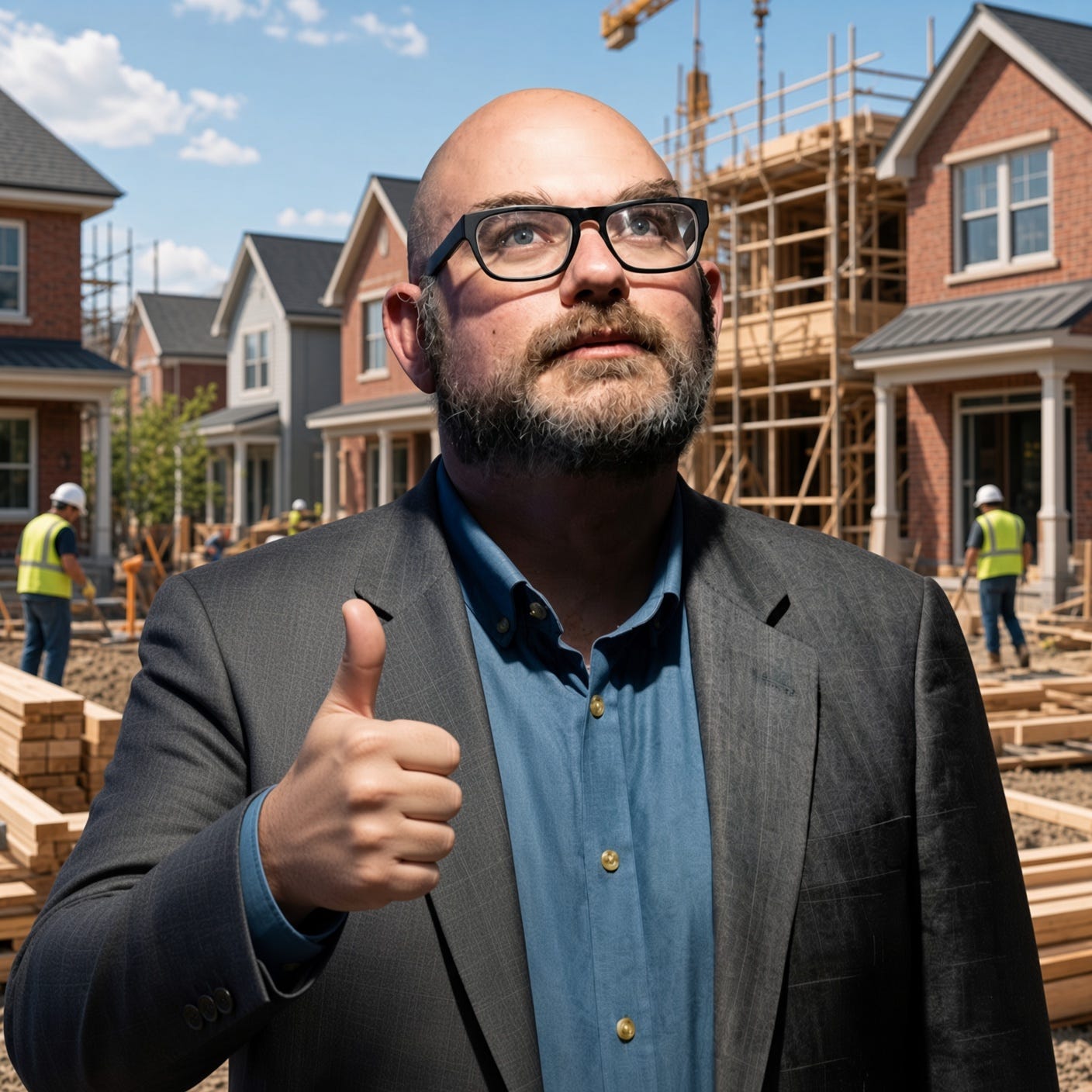
Today Matt Yglesias released an essay, “YIMBYs already have a bold vision for solving the housing crisis: Don’t listen to the haters — there’s nothing narrow about this.” The principle he articulates is straightforward: more housing is needed. The work required to deliver it, however, is infinite. It demands perpetual, chronic, never-ending effort.
And that effort, lest we forget, is fundamentally about restoring traditional property rights.
Yglesias writes:
“YIMBYs, people in the housing abundance movement, do not have a pope or a set of sacred authoritative texts you can consult to find out what we think about things. But if you asked me what YIMBYism is, I would say our big idea is that if some land is zoned for human development… and the person who owns the land would like to build housing on that land, he or she should be allowed to do so, subject to bona fide regulations related to building safety and environmental externalities. This is a radical idea. There is literally nowhere in the United States of America (no, not even Houston) where it works like that.”
Opponents of this liberalism are largely in retreat. What remains is mostly a fringe of left-wing academics—often Boomers—and their downwardly mobile students—often in Gen Y and Z. They do not surrender because their entire ideology rests on the premise that markets are inherently destructive and businesspeople are inherently suspect. Lacking a credible Plan B, they double and triple down on their manufactured narrative, even as it grows more preposterous and their practical influence wanes.
In my experience, the most virulent objections to additional housing and the restoration of property rights come from academics. Yglesias cites a piece, by Vanderbilt law professors Christopher Serkin and Daniel Sharfstein that takes the familiar, lazy route: the state should simply build more housing.
The authors ignore nearly a century of case studies demonstrating that governments are generally terrible at producing housing, reckless with eminent domain, indifferent to construction costs, and dismissive about community design and long-term management. Serkin and Sharfstein propose treating housing as infrastructure, as if America’s actual record of developing and maintaining infrastructure were a model of efficiency.
Academics default to “markets bad, state good” for several reasons. The academy is generally anti-business, or at least business-skeptical. There is also a form of envy that arises from being highly credentialed yet relatively ineffective at shaping one’s own community. When people with the highest degrees watch Bubba in an F-150 build a neighborhood of homes while they themselves produce none, resentment can set in.
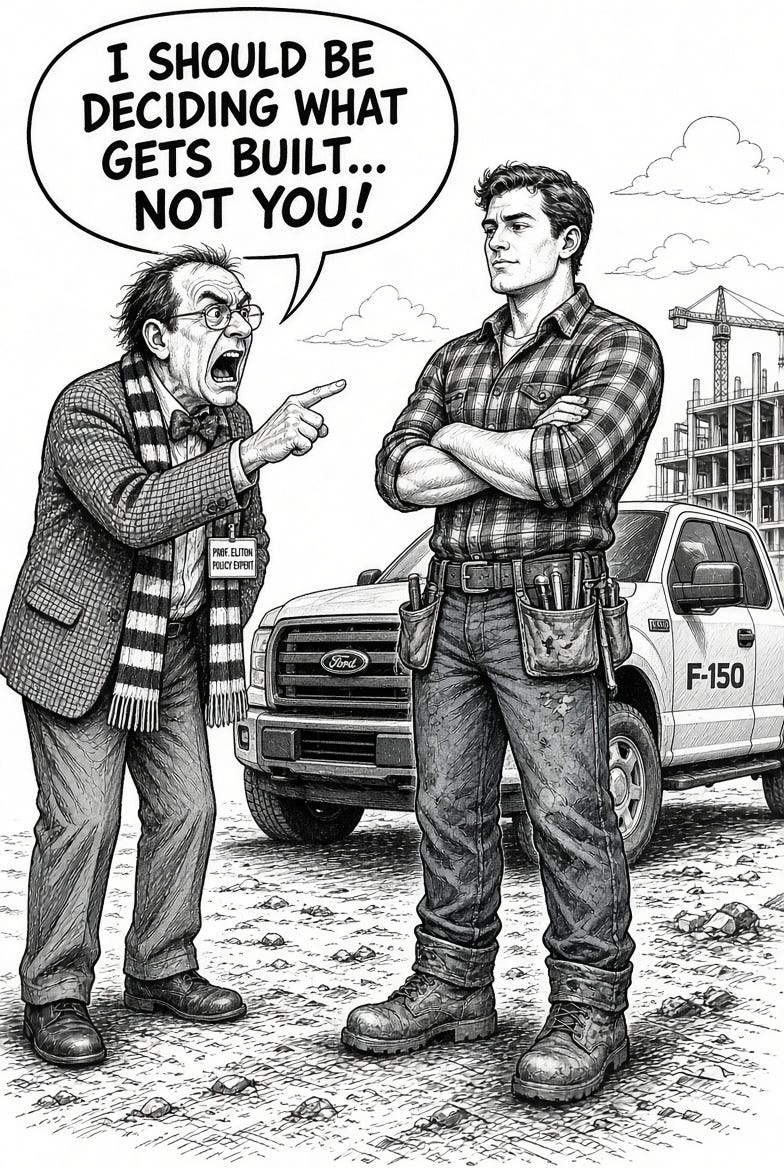
For most academics, this remains a non-issue; they let Bubba build and return to their metaphysics, or whatever. For a non-trivial minority, however, the jealousy is directed at Bubba and at the politicians who protect his right to build. These voices often appear off—hateful, spiteful, entitled. Some publish falsehoods about applicants, coordinate hit jobs with aligned media and politicians, or dox builders’ home addresses as a form of threat.
Intellectuals are drawn to public engagement in part because it lacks the ordinary filters that discipline other domains. A bad employee can be fired; a difficult relative may eventually stop receiving Thanksgiving invitations. But public commentary lacks such a mechanism. Highly credentialed but low-impact individuals therefore gravitate toward the public microphone.
Because land use has been heavily politicized for the past two decades, the primary targets become those who actually work the land and supply housing—the builders.
The root problem is politicization itself. As Yglesias observes:
“Because if we can solve the single biggest economic problem facing the country with a liberalizing reform, that calls into question the larger project of overthrowing ‘neo’-liberalism and replacing it with a new post-liberal economic order.”
Indeed. Property rights reform, particularly the right to build housing by right, is an existential threat to this NIMBY class. This is why the NIMBY left—mostly made up of the planner left and the academic left—remain so invested in keeping land use politicized.
If land-use decisions were depoliticized, what community purpose would they retain? Since few, if any, of them build anything themselves, what remaining power would they hold to mold their communities?
Scarcity is a deliberate policy choice, the consequences of which we all now regret.
To continue successes, Yglesias suggests that YIMBYs must reassure suburban homeowners that reform will not transform their neighborhoods into Manhattan. It will not. He also urges YIMBYs to confront left-leaning voices who dismiss abundance reforms as small potatoes. In his view, housing remains the largest policy lever available to state and local governments, and under John Myers & Sam Bowman & Ben Southwood’s The Housing Theory of Everything, housing is connected to, well, everything.
I find these juxtaposed objections somewhat amusing. Experienced YIMBYs already recognize the pattern: Chronic NIMBYs (who are often involved in anti-housing advocacy every month, year after year) will claim, simultaneously, that reforms are so extreme they will turn cities into Manhattan and also that reforms are so modest as to be inconsequential.
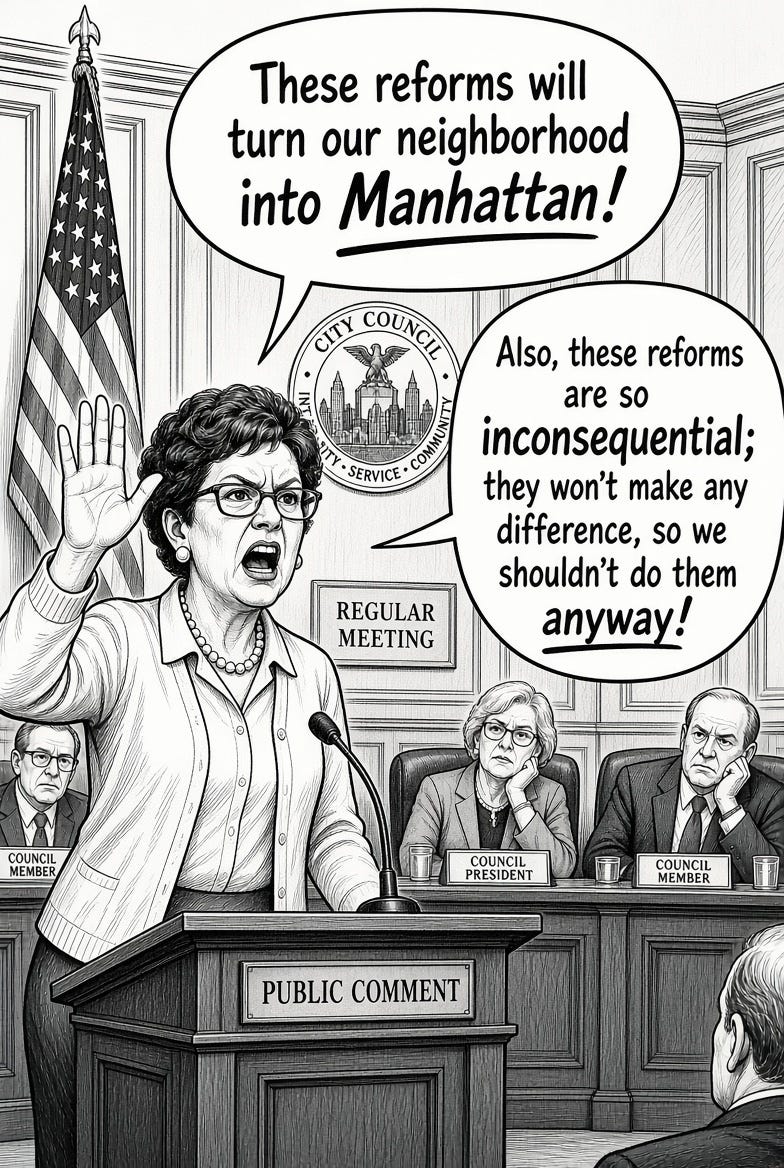
In other words, NIMBYs regularly throw two completely contradictory objections at the wall to see which, if either, will stick. These arguments typically emanate from the highly credentialed, low-competence cohort. Because the contradiction is obvious, the objections are best ignored.

In the end, the question is binary. People either believe in individual agency or they do not. They either believe Americans possess the right to build housing on land zoned for human development, or they do not. As Yglesias concludes: “If you’re looking for a bold, expansive vision of a better world, get on the housing abundance bandwagon, because scarcity is a deliberate policy choice the consequences of which we all now regret.”
Indeed. We regret. The question is, “What are we going to do about it?”
Aaron Lubeck
Aaron Lubeck is a designer, builder + developer with The Rocket Shop in Durham. He is the author of Green Restorations: Sustainable Building and Historic Homes, and a former adjunct at Duke University’s Nicholas School, where he lectured on sustainable home building. In 2012, Aaron developed Durham’s first net-zero-energy home, an infill project designed to fit seamlessly in its historic neighborhood.
Aaron’s more recent work focuses on zoning changes to facilitate the reconstruction of affordable housing markets, including local efforts to create Missing Middle codes. He recently served as faculty with Incremental Development Alliance in West Atlanta, training fledgling developers, and is host of The Townbuilder’s Podcast, a curated conversation with top new urbanist developers. He is t
he founder of Southern Urbanism, a non-profit dedicated to better city-building in the South. @aaron_lubeck


You’re bout 1000% better at punditry than Yglesias. And especially because you’ve actually built things in the real world.
Yglesias and Jerusalem Demsas touched on this in one of their podcasts called "Does the oligarchy exist?" where they essentially argued much of the "oligarchy" is upper middle class professionals & professional organizations. It's the dentists who don't want competition from new dentists, so they make it prohibitively difficult and expensive to become a dentist. Not sure that I'd define that as "oligarchy," but it is certainly an ongoing problem in every industry. Your perspective is from a highly educated college town -- but I suspect the same NIMBY trend holds true for upper middle class non-academics across the country
https://www.theargumentmag.com/p/does-the-oligarchy-exist