


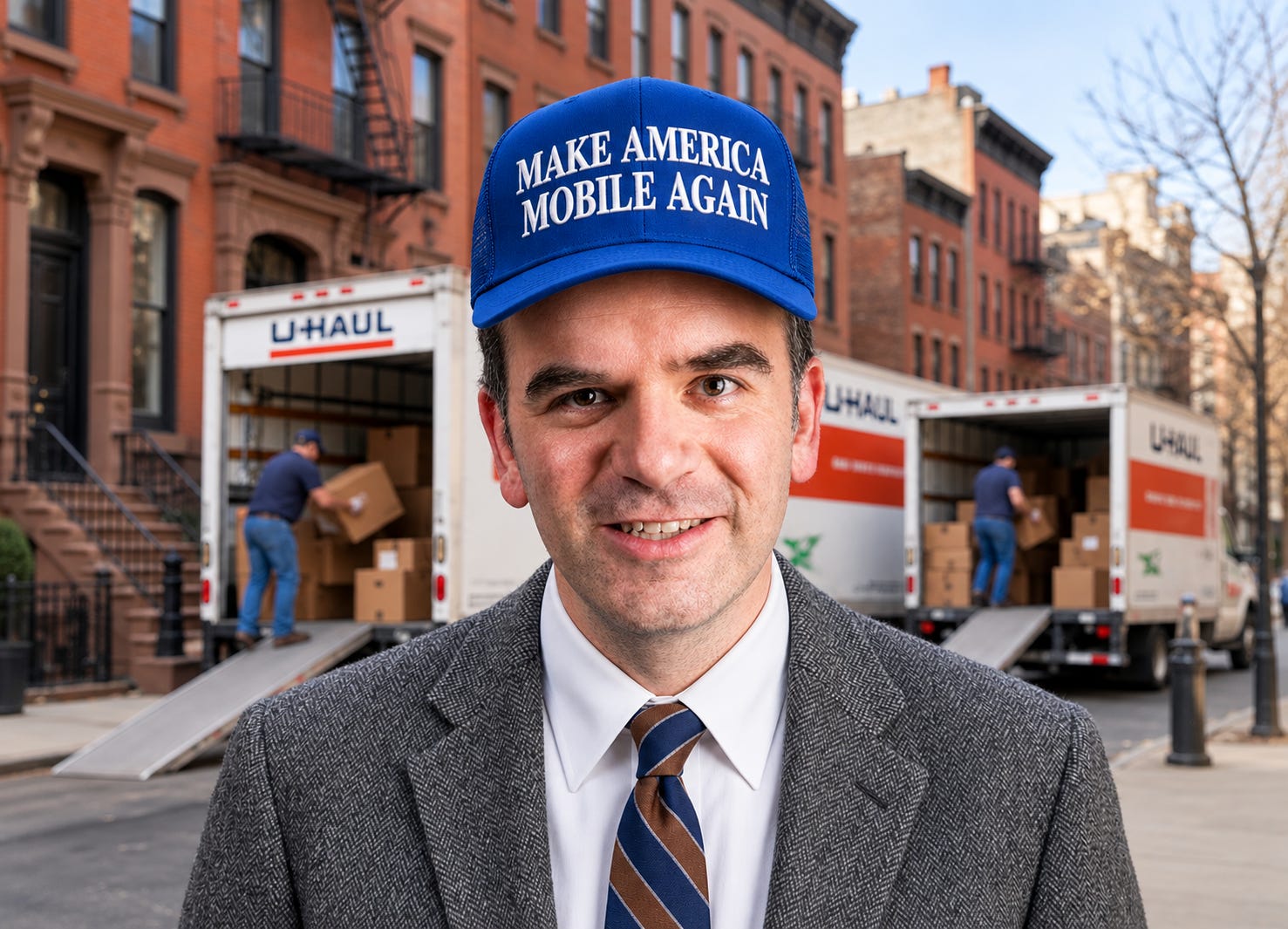
This is the second piece on Yoni Appelbaum’s Stuck. The first was about the book. This one is about the word I think policymakers should steal from it—particularly progressive leaders who are searching for a long-term winning narrative.
RALEIGH, NORTH CAROLINA | After twenty-five years working to build better cities, it’s clear to me we need a new definition for “mobility.”
In my experience, the word “mobility” almost always means transit. Usually, though not always, it means more walking and cycling coupled with fewer cars. A car-skeptic version adds mass transit, while a more conservative alternative replaces swaps it for the personal automobile (as seen below).
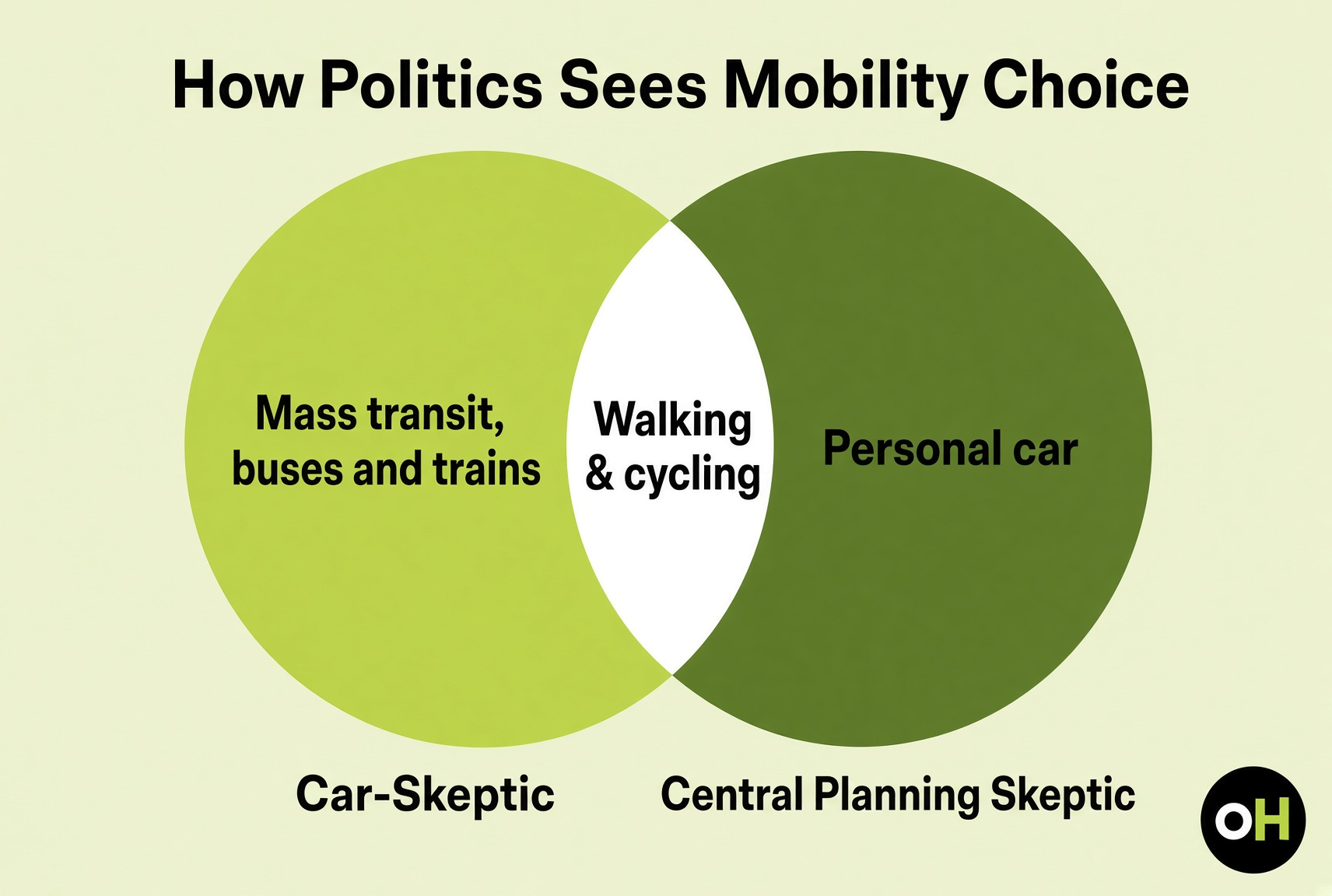
But “mobility” is about something else. And it’s a much, much bigger idea. Mobility isn't just about the place you’re going. It’s why you’re going there, what it means to be there, and what you hope to do when you arrive. It is not just getting to a job or a school or a store faster. “Mobility” is far more meaningful, and less utilitarian, than today’s dominant definition implies.
That is precisely what Yoni Appelbaum’s book is about.

When I led a CityBuilder book club on Stuck in Raleigh this September, series curator Payton Chung asked everyone to “introduce yourselves, and say why you are stuck”. It was a revealing exercise. Everyone had unique, rich, and diverse challenges they were facing. I still had to point out that “stuck,” as open as the word sounds in conversation, has a very specific meaning in the book. To Appelbaum, “stuck” results from being immobile. Stuck is what you are when you lose choices. Stuck is what you are when you lose agency and the chance to improve yourself. Appelbaum says those choices are directly tied to how well you can pack up and move.
If there is one takeaway from the book, it is that policymakers should aim their policies at methods that keep America moving — and make it more mobile than it is today.
The numbers make the point without much help. In the nineteenth century, about one in three Americans moved in a given year. As late as 1970, it was still about one in five. Recently it has been about one in thirteen. More and more, the people who can still move toward opportunity are the affluent and the well-educated. For everybody else, moving to the place with the better job often means losing the bet to housing costs.
That is why it is critical that America stay mobile. If there is one takeaway from the book, it is that policymakers should aim their policies at methods that keep America moving — and make it more mobile than it is today.
MAKE AMERICA MOBILE AGAIN
I like “The Mobility Message” because it is more specific and more actionable than the general Abundance thesis. How do we make America mobile? Many ways, but here are three:
1. Make housing abundant
First, to be mobile again, housing has to be abundant. America has to be a buyers’ market and a renters’ market. It is only a seller’s market, or a landlord’s market, when housing is scarce. The only way to get there is to flood the market with supply. And that supply has to be great. Or at least better. That is what late-nineteenth-century America did, and Appelbaum tells that story well.
One thing we discussed in the book club: on Moving Day, as he describes it, as much as a third of a city like Boston or Philadelphia might relocate in a single day. Women often scouted the next place. The move was almost always up — better housing, with more amenities, in a better location. It helped that America was young, ambitious, optimistic, and hustling. You could see these values in the streets on any Moving Day.
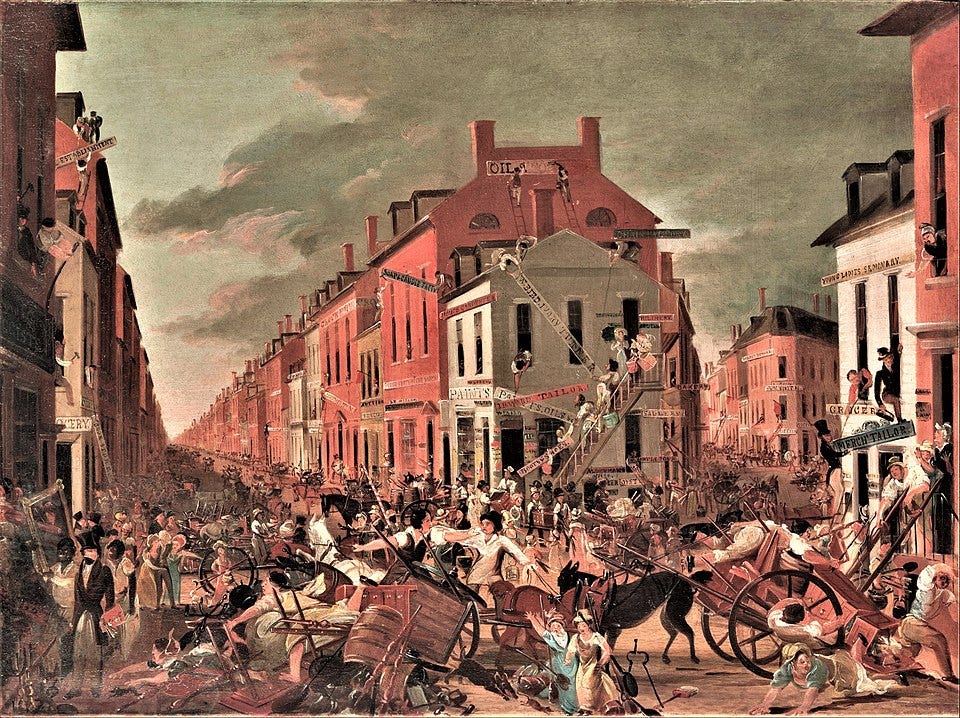
There are no real anecdotes in the book, or in the 19th-century history I know, of “gentrification” as we now use the word. Change was constant. But elastic supply let builders keep building and meet demand. As long as housing was abundant where people wanted to be, gentrification—in the modern sense—simply didn’t happen.
We are far from that system in 2026. Today, gentrification happens because builders can't build where people want to be, and citizens cannot reasonably provide housing for their fellow man. Thus, a growing number of people fight over increasingly limited resources and, since we allocate scarcity by price, money wins out. That’s how gentrification happens. It’s an inevitable consequence of artificial scarcity. Artificial scarcity is the inevitable consequence of politicized planning, which politicizes housing. Appelbaum’s line is exact: “Housing has grown artificially scarce and prohibitively expensive.” We know how that ends. And we know abundant housing fixes it.
2. Densify metros
Second, we need to densify metros. That is the underlying thesis of urbanism. Abundance at the unit scale and density at the metro scale are the same project seen from two distances.
Most of the country's fast-growing regions are sprawling. Places like Arizona and North Carolina were until recently agrarian or sparse; we are urbanizing both for the first time. That is much harder to do in 2026 under the twin encumbrances of sprawl-inducing planning institutions and open-space-demanding environmentalism. In my view, we now live in an Orwellian arrangement: urban planning, as practiced, is actually suburban planning, and environmentalism, as practiced in the anti-density advocacy of California’s Sierra Club, is one of the biggest threats to the environment. Calling a spade a spade, Appelbaum notes that “Opposition to mobility appears concentrated in progressive jurisdictions.”
Well, that sucks. It’s no wonder so many Americans are leaving these jurisdictions. And it’s no wonder why the Electoral College is scheduled to turn catastrophic for the blue team in the next decade. Something must be done.
3. Invest in Institutions Committed to Mobility
Lastly, we need a new movement with institutions committed to these principles of mobility. New Urbanism is a candidate. So is YIMBY. The best two, me thinks. I think they ultimately need to merge. Or at least align. Densification takes many shapes; and densification is broadly what successful New Urbanist and YIMBY reforms produce. These reforms come at the expense of a 100-year-old American planning tradition of exclusion and a 50-year-old plutocratic vetocracy that has leveraged political connectivity to prevent housing in every way possible. Both are now waning phenomena. Their declines are a prerequisite to building metros that are more equitable, freer, more urban — and more mobile.

Mobility gets easier when things are dense. And, contrary to the narrative that city transportation has to be complex and expensive, it does not. I spent time designing my city’s schematic framework for a bicycle boulevard network. It was fun and rewarding. It was also incredibly simple. Most high-school students could have done it after reading Portland’s (remarkably simple) Bicycle Boulevard Design Guidebook. When density is done well, mobility can be as simple as safe bike infrastructure — even just bike boulevards, as built in Portland, Seattle, and Berkeley. Infrastructure does not have to be expensive to be abundant. But cities have to be dense enough to use it. In my view, then, practically speaking, mobility correlates with density.
A POLITICAL WINNER
“The drastic decline in geographic mobility is the single most important social change of the past half century, and perhaps the least remarked.” Appelbaum brought this fact into the light. More policymakers should be talking about it.
“The notion that people should be able to choose their own communities — instead of being stuck where they happen to be born — is America’s most profound contribution to the world.” That right to arrive is now written into American law. The idea is still unusual worldwide. For most of human history, a “right to arrive” would have sounded ridiculous. It is an American tradition worth celebrating. Today it goes mostly unacknowledged. Which is precisely why it is a low-hanging fruit political opportunity for a party that simply wants to acknowledge it.
How do we get people moving?
How do we give them choice?
How do we create abundant housing options?
How do we make it so most people can get around without a car and still reach jobs, school, faith, friendship, and a shot at starting something they can call their own?
Because frankly, once we allow people to be mobile again, everything else might take care of itself.
