


Tomorrow, it will have been 20 years since the fateful night of the Duke Lacrosse Incident.
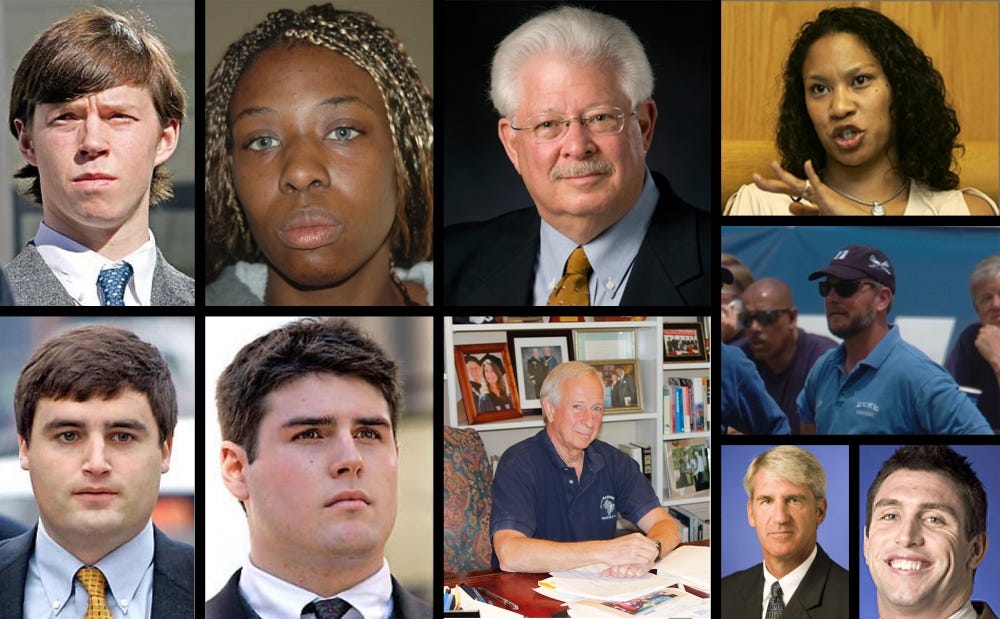
On March 13, 2006, while on spring break, the team hired a local stripper, who accused them of rape, setting off a media and social frenzy that monopolized Durham and SportsCenter for 13 long and painful months.
During those tense times, the Trinity Park neighborhood (where I live) and the university consumed themselves by throwing the student-athletes under the bus, while the wider community reacted with a frenzied groupthink worthy of Lord of the Flies.

Only later did we all realize, at unprecedented cost, that the whole thing was a salacious hoax.
In 2024, the accuser admitted in interviews that she had fabricated the allegations. After lawsuits were settled, “The Lacrosse House,” as it became known, was demolished, and I built the house that replaced it (with an unusual process, which you can read about here).
Today, I do not care to rehash the facts of the case or my redevelopment project. Instead, I want to talk about what our community learned from the case, during the ensuing decades of repair—and why I am concerned that we have learned nothing at all.
Defining the Cultural Underpinnings
It’s hard to remember now, but this political movement, which would dominate national politics and media ten years later, barely had a name in 2006. Identitarian politics had long been simmering in college towns, but hadn’t yet exploded onto the national stage. The Duke Lacrosse case revealed how susceptible narrative-driven institutions are to abandoning truth. These politics are colloquially captured by the irritatingly controversial term “woke.”
In my view, the Duke Lacrosse case was the first shot in these Woke Wars.
Before articulating my own frustrations and before we get back to the events as they unfolded, it helps to give some background on how we got here, particularly the academy’s role in creating the ecosystem that allow these events to flourish.
Let’s first define the term “woke” through the meanings offered by cultural critics and popular journalists. There is some commonality across the political spectrum, and virtually all now use the term pejoratively.
On the liberal-leaning side:
Matt Yglesias described the social-justice ideology dominant among educated urban progressives, especially in media and academia, as “The Great Awokening.”
In Woke Racism, John McWhorter defined “woke” as a belief system resembling a religion that treats disparities as evidence of systemic oppression that, in turn, requires ideological conformity.
Sam Harris, in a blog post Can We Pull Back From The Brink, expressed frustration with “the bad-faith arguments, the double standards, the goal-post shifting, the idiotic opinion pieces… the general hysteria that the cult of wokeness has produced.”
Conservatives, meanwhile, focus their definitions on the hierarchical but ostensibly equal relationship between victimhood and the elites claiming dominion over the victims:
Douglas Murray in The Madness of Crowds saw woke as identity politics where moral authority flows from victimhood status.
Andrew Sullivan, in America’s New Religions (among others), argued that woke is a progressive ideology centered on structural oppression and moral purification, using language and social enforcement, with conformity viciously enforced by the threat of cancellation.
Our College Towns’ Inevitable Role
With all of these definitions rooted in postmodern intersectionality, this problem was always going to be centered in college towns. Cultural critic Freddie deBoer argued that the woke ideology emerging from elite universities fuses critical theory, anti-racism frameworks, and identity politics. All the ingredients—crock-potting and soon to explode in our story—are there.
Durham was a powder keg just waiting to be lit
Now, Duke isn’t the most activist of campuses (I reserve that title for UC-Berkeley and the University of Michigan), but Durham is an activist town. It is populated with outlier people advocating for this and that—some good, some bad, but always loud. At times, loud voices from the town and gown combine to flywheel each other.
I have personally witnessed wokeness split the progressive party into constructive and destructive wings. Obama once quipped that he “came from the progressive wing of the Democratic Party” (often poeticized as “the progressive wing of the progressive party”), implying that there is a regressive wing, too, and he ain’t that.
Much of our local political scene in Durham follows the same divide: liberal vs. left, forward-moving progress vs. a kind that, at times, seems determined to burn the city to the ground just so it can rule over the ashes. That latter variant is that regressive wing.

Mike Nifong, Durham’s District Attorney prosecuting the accused lacrosse players, understood that the accuser’s story fit this narrative the moment he saw it. And once a narrative becomes politically useful, evidence becomes inconvenient. In Durham, DAs are elected, and, as fate would have it, Nifong was in a contested primary. Weak and spineless, Nifong bought the accuser’s story hook, line, and sinker. He appeared less a leader of the cult than a useful idiot to be weaponized, which he was.
For Durham, the Judiciary was supposed to be the last line of decency’s defense. When his office fell, Nifong plunged the university, the city, and all of its residents into 13 months of hell.
“There’s no doubt a sexual assault took place,” Nifong famously declared — a statement worthy of disbarment, which eventually came in June of 2007.
From an oppressor vs. oppressed worldview, the Duke Lacrosse story could not have been more perfectly scripted.
For Nifong, truth was dismissed as inconsistent with the narrative. Due process be damned. His legacy is now forever cemented as a public servant who sought to enforce ideological conformity through cancellation.
To hell with the truth, he effectively said. That’s woke.
As the product of seven (yes, 7) college towns and the son of two PhDs, I get this ideology. I don’t approve of it, but I get it. When you are raised in Chapel Hill and Ann Arbor, you absorb the steady, canonical proselytization that businesspeople are unimpeachably bad, intellectuals are unimpeachably good, and this black-and-white thinking governs most discourse. It’s an easy way to make sense of the world, which makes it attractive, I guess, even if it’s not true.
Reality, of course, is more nuanced: we’re all horrifically messed up, and we all have good and bad in our hearts. Wokeness permits no such nuance. Which is why reasoned people find it childish.
The Powder Keg
Back to the spring of 2006, you can now understand how wokeness in Durham was a powder keg just waiting to be lit. The gunpowder was this toxic, yet-to-be-named ideology, lurking just below the surface.
From an oppressor vs. oppressed worldview, the Duke Lacrosse story could not have been more perfectly scripted. It was:
White versus Black.
Rich versus Poor.
North versus South.
Gown versus Town.
20 years ago, the fuse was lit. Journalists (long suckers for the aforementioned narrative) immediately poured fuel on the fire. It’s as if they said, “Aha! This is what we’ve been told is true. This is what we’ve been waiting for. We must now act to tell others about this truth.”
In this environment, privilege was synonymous with guilt. There was simply no universe in which the wealthy kids could be telling the truth and the poorer woman could be lying. I vividly remember the vibe—you could feel in the air in Trinity Park— how badly some people wanted the story to be true.
Except it wasn’t.
After years of civil rights litigation, it appears that the exonerated players each walked away with roughly $20 million (some say more). William Cohan’s book The Price of Silence put Duke’s total costs above $100 million. The city spent nearly $4 million in legal fees defending against claims of Nifong’s misconduct.
The financial toll was staggering, but the cultural damage was far worse: a collapse in trust in the judicial system, trust in the DA’s office, Duke’s administration, the academy, and—for me, the biggest blow—trust in the media.
Before Nifong became the last line of defence, a functioning fourth estate (journalism) should have acted as a watchdog and held leaders accountable. It didn’t do either of these things.
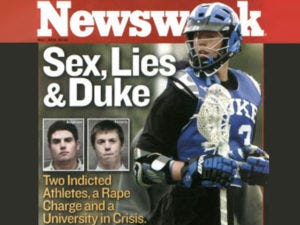
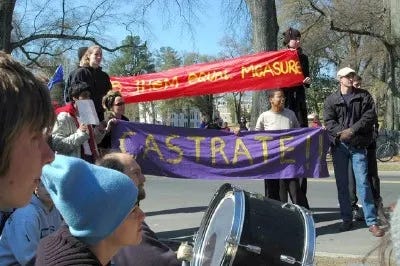
Instead of bringing a firehose to a dumpster fire, media institutions poured gas on the flames. Headlines everywhere presumed guilt: Nancy Grace quipped, “I’m so glad they didn’t miss a lacrosse game over a little thing like gang rape!” Newsweek ran a cover that said “Sex, Lies and Duke.” The INDY Week repeatedly framed the case in terms of race and privilege, then endorsed Nifong for DA. The Duke faculty “Group of 88” publicly thanked protesters waving “castrate” signs and “wanted” posters of the players. For many, watching academics (also members of the fourth estate, in my view) publish emotionally charged political conclusions without evidence was the last straw.
What Have We Learned?
Twenty years later, did any of the offending groups learn their lesson?
I fear they have not. Fringy activists still dominate public discourse with the same us-versus-them narratives, ready to blow off with the next hair-trigger issue of the day.
But why? I suspect, in part, it is because in America — and especially in college towns — we practice a brand of politics that treats all voices as equally valid. For people who struggle to be heard in their personal and professional lives, the public microphone is always on. For others, who identify as radicals or revolutionaries, the public square can feel like the only place to be heard. And because political discourse is predominantly about land use, these days, people simply go to where the puck is. The default script mirrors the same lazy 2006 formula. It is built on othering and demagoguery, only recalibrated for today’s politics: “them = oppressor”, “builder = bad”, “me = victim”, yada yada.
And, critically, a common denominator of all of this is a lack of recourse. Lack of responsibility. A public speaker libeling a builder has nothing more to lose than a tenured professor who demands that his student admit to crimes he didn’t commit. A recourse-free world is one without the guardrails of decency. This means that the ideology and systems that fueled the Duke Lacrosse case 1) still exist and 2) are now overrepresented in land-use politics.
Remarkably, it’s not that many people. In today’s world, it doesn't take more than a dozen reckless and irresponsible people to really screw up a city, particularly when a few of those are in power.
Unfortunately, local media still regularly amplifies these voices, repackaging the powder keg for a new generation. I am certain it will go off again. This is a culture that collectively inverted the rules — starting with truth itself. It has now been 20 years, and I see no evidence that it ever fully reverted back.
In 2026, most of the country has moved on from woke and all its varied definitions. Our current president rode into office on the coattails of the backlash. Most now see woke for what it is: a dead-end ideology. I think that if you can't learn from the trainwreck of the Lacrosse case, and still can’t learn from Donald Trump’s election, then you don’t want to learn. And you never will.
It’s on sincere and good-hearted progressives, then, to sever these uneducable elements from the party. Otherwise, “blueness” will never be viable at the (southern) state level or nationally. Instead, blueness will forever stay fenced off in college towns — exactly as Jesse Helms once suggested. Except now it is the hard-core identitarians from inside the house who are building the fence. And, by handcuffing itself to the woke wing, Obama’s progressive wing of the progressive party is chaining itself to the prisoners building their own prison. That’s a tough strategy to win on. It certainly won’t play in Peoria. Or Pamlico.
So long as that Jesse Helms’s fence remains, expect more Duke Lacrosse debacles, more pre-baked media narratives fanning the flames, and more college towns sabotaged for the benefit of the woke.
Lessons to Carry Forward
The events of the Duke Lacrosse case are ancient history for many now — most kids at Duke today were not even born in 2006. But the effects linger. And the lessons should never be forgotten, as they remain relevant today. The same vibes-based politics that created the Duke Lacrosse Case continue to shape (and undermine) land-use policy.
I will close with the two things I have learned, which perhaps can chart a better way forward:
Never give power to people who shirk accountability. Power without responsibility is disastrous. That’s exactly what happened when the DA went rogue, local editors piled on, Duke’s leaders dismissed due process, and the media failed to guardrail the prevailing crazy. The Lacrosse case spiraled out of control because the bad actors believed 1) they would personally gain by piling on, and 2) there would be no consequences if things went awry. Nifong thought he was doing God’s work. So did Nancy Grace. So did the Group of 88. They saw themselves as superior. To feel superior, they needed scapegoats. And when it all came crashing down, and the bills came due (for the city’s taxpayers and Duke’s donor class), they vanished like Keyser Söze.
Get—and keep—those who shirk responsibility out of power. Don’t elect them. If you did, throw them out. Don’t support them. If you do, stop. A decent society must limit the opportunities for narcissists to harm decent people through abuse of bad-faith activism and self-congratulatory media.
Those two solutions, while not easy, are that simple. Because in 2006, had any one of these guardrails worked, none of this nonsense would have happened.
Twenty years later, the only question left is: have we learned anything?

(Keywords for SEO: Duke Lacrosse 20 years, Duke Lacrosse hoax anniversary, woke Durham, get woke go broke, Durham NIMBY, participatory planning)
More reading:

Another lesson from the Duke Lacrosse case is that Elections make politicians do dumb things.
Nifong wasn't a skilled politician, but he recognized the political pressure not to tell the truth. At some point, he just got in too deep and found himself in a trap. I see this a lot in woke politicians-it's just another reason to not elect them.
You’re absolutely right that Duke circa 2005 was woke avant la lettre. I was a student there at the time and some of the things that happened around the lacrosse case scarred me for life.