

A friend of mine, Rick Cole, recently posted a reflection on credentialism that resonated deeply with me. It put clear language to something many of us who work in housing and city-building experience firsthand but struggle to articulate:
Too many land-use decisions today are driven not by judgment, experience, or outcomes—but by résumé suffixes.
Credentialism is the belief that a person’s authority flows primarily from licenses, degrees, or institutional affiliations rather than from intelligence, lived experience, tacit knowledge, or demonstrated competence. In housing and planning, credentialism has become a quiet but dangerous force. Our cities are too often governed by JDs, PhDs, and AICPs who have never designed a building or site plan, never pulled a permit, balanced a pro forma, or tried to make a project work in the real world.
Many credentialed professionals are thoughtful, ethical, and effective public servants. But credentialism—especially when paired with inexperience bordering on incompetence—too often produces something far worse: abuse of process, moral arrogance, and policy cruelty disguised as expertise. In these cases:
CREDENTIALISM + INCOMPETENCE → NARCISSISM + PSYCOPATHY
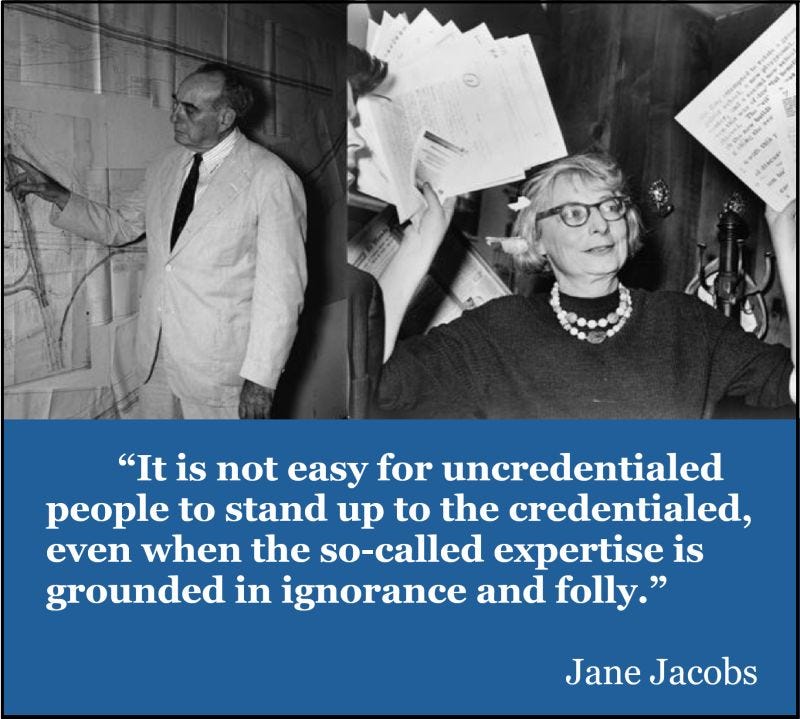
Rick Cole frames this problem through the most important unresolved conflict in American urbanism: Robert Moses versus Jane Jacobs—the heavy-handed, top-down technocrat versus the grassroots journalist-observer. The credentialed staffer versus the people.
Rick Cole’s Statement
In December, Rick published this statement on LinkedIn:
Robert Moses was the credentialed expert whose prescription for New York City was bent on destroying its street life and urban vitality. Jane Jacobs was a journalist appalled at the cruel and misguided bulldozing of neighborhoods to be replaced by sterile and car-centric “development.”
65 years later, even professional city planning “experts” have largely come around to some version of Jacobs’ critique, although few cities have actually embraced their own assets of streetlife, local entrepreneurs, placemaking and rebalancing transportation away from cars. It’s unfortunately true that her lament of thirty years after the publication of her masterwork, The Death and Life of Great American Cities, that “Anticity planning remains amazingly sturdy in American cities . . . embodied in thousands of regulations and codes, also in bureaucratic timidities owing to accepted practices and in unexamined public attitudes hardened by time” -- is still true!
Expertise is valuable, but it needs to be anchored in the timeless ways of building human habitat and grounded in the clear-eyed observation of what actually is working and promoting more of it.
Jacobs was a profound thinker, but no idealogue. We need less lip service to her legacy and more courage to reform our embedded regulations and codes and unleash the creative energy of small-scale innovation and vitality.
Pasadena’s Zoning Code is nearly 300,000 words, nearly as voluminous as Tolstoy’s classic tome, War and Peace. It’s visionary goals are undercut by decades of layered regulations that are often vague, inconsistent or counter-productive (sometimes all three).
Let’s emulate Jacobs’ practice of rigorous criticism of the ignorance, folly and timidity of so much current “city planning” and end the rule of cars -- and make cities for people!
Cole’s argument is not anti-expertise. It is anti-detached expertise—it is against centralized authority divorced from observation, practice, and accountability. Perhaps credentials are now used as an excuse not to do the work that so desperately needs to be done.
LATTER DAY CREDENTIAL ABUSE
I have watched AICP-certified “urban” planners defend parking mandates that induce suburban development. I have watched public servants quietly advise residents on how to stop projects that were still pending hearings they themselves would later preside over. I have watched ostensibly neutral planning commissioners orchestrate FOIA ambushes days before consequential votes with the express intent of destroying political dissenters’ reputations. I have watched CNU-A–certified planners advocate against nearly everything the Charter for the New Urbanism stands for.
Credentialism is the belief that a person’s authority flows primarily from licenses, degrees, or institutional affiliations rather than from intelligence, lived experience, tacit knowledge, or demonstrated competence.
Today’s Credentialism is not theoretical. It is formulaic. It is tactical. It is the smoke under which bad-faith people conduct their bad-faithery. It converts the power of public process into moral authority. And, these days, it is corrosive. At this point in my career, I see someone with an AICP credential as a red flag. Why? Because I have just personally seen too many instances of bad behavior by those with that AICP credential.
THE COLLEGE TOWN CREDENTIAL CONUNDRUM
Why has it gotten so bad? As progressivism matured, it has increasingly relied on the academy for its intellectual spine. Few institutions fetishize credentials more than academia. Power is gated behind degrees; before the PhD, you are labor, often poorly paid, serving the PhD. Afterward, you are granted authority. Elite institutions run on a culture of “kiss up, kick down”. The credential becomes not merely evidence of training, but a mechanism of exclusion whose value depends on minimizing the legitimacy of those without it.
That helps explain why so many of the loudest NIMBY voices happen to possess doctorates, which—often hilariously—always seem to be in fields entirely unrelated to housing, construction, or land use. “I have a PhD,” we are told—in something like ethnopharmacology or literary theory—“so let me explain zoning to you.”
In Jane Jacobs’ mid-century, credentialism was simpler. Being white and male was the primary ticket. Being Ivy League all but assured power. Yale University provided Robert Moses with institutional cover as he amassed extraordinary power through manipulation rather than competence. Conversely, Jane Jacobs ultimately prevailed not because she had credentials, but because she observed clearly, reasoned honestly, and told the truth—publicly.
Today’s credentialism is more fragmented and more aggressively abused. In public meetings, identity, academic status, nonprofit affiliation, and even poverty itself are treated as unimpeachable credentials. I have watched local NIMBY campaigns recruit speakers almost entirely for the optics of their credentials. I have watched public-housing residents handed scripts to slander builders they had never met. I have watched a PhD inserted 195 weeks into a 200-week reform process and encouraged to offer “expert testimony” to demand a full engagement reset, so a research agenda could be built on postponement. I have watched nonprofit housing leaders oppose housing because the social rewards of “good vibes” outweighed the obligation to build homes.
Such is credentialism in the modern age.
Each credential becomes a shield. And each shield becomes a veto. Debate ends, not because the argument is wrong, but because the speaker is deemed to be above critique. In these cases, credentialism is played as a trump card. And for housing obstructors, then, the goal is to flood the field with trump cards.
This is the Moses playbook, updated for the credential age.
The solution is not to reject expertise. It is to demand accountability from experts.
HOW DO WE FIX THIS?
Credential-issuing institutions—from the academy to the Congress for the New Urbanism to the American Planning Association—must have clear, transparent, and frequently used hearing procedures to strip credentials from those who abuse them.
If the academy never expels anyone, why should anyone trust the academy? And if the many narcissists among us are made aware that credentials are a path to power, and there is no consequence for abuse of that power, won't they be naturally attracted to the no-cost nature of credential procurement?
If professional organizations certify people who openly violate their own stated principles—and never act to apply recourse for such behavior—then credentials become meaningless business-card ornaments. That’s on the credential-granting organizations and their good-faith members to defend.
Jane Jacobs did not win because she was anti-expert. She won because she was right—and because she was willing to challenge authority without institutional permission.
The problem isn’t that expertise is overrated. It’s that we’ve stopped demanding competence from experts.

So I have to out myself as a credentialed urban planner (Canadian, not AICP - we hold hearings and discipline). More importantly my viewpoint is Canadian, so more of a cousin to what you are saying in America.
Yes and no, I think for your argument. In general, I think professions are losing their status (partly due to what you describe). You are describing something insidious, but I'm not sure if the issue is credentialism per say. I think it's more our North American society is in continual retreat from lived experience. We rely on theory, data, abstraction more than we should. This has seeped into all professions (credentialed or not).
You describe non-profit affiliation and poverty as a credential. That's certainly not the same thing as a professional engineer or MD, a credentialed professional. I think the broadest problem is there is a massive lack of trust, a lack of civic decency, combined with a weird detachment from real expertise as opposed to theory.
Yes - there are certainly credentialed planners (and other professions) who are bad at their jobs. There are some that are unethical (although in my experience planners tend to be idealistic and very ethical - self selection). How to fix the problem of incompetence is harder to say. Advice that people don't like is not necessarily incompetence. My ideal planner actual provides balanced advice - here are two strong options, taking different approaches - let's work together to choose one (or something different). It's very hard to do.
Hey some of us PhDs in unrelated fields are on the pro-housing side too! lol