

I was playing tennis with Rory Dowling, a private-public partnership developer and a graduate of UNC’s planning and business schools, and we were gabbing about Atlanta’s Beltline, He said, “I hope Durham’s is going to be similar”, crossing his fingers. Sadly, I had to pour water on his vision. The Durham Rail Trail is not going to be similar.
The City of Durham unveiled a new Durham Rail Trail video on its YouTube channel on June 17, 2024. Like the proposed plan, the video is gold-plated.
The plan was produced by McAdams, one of North Carolina’s major civil engineering firms—responsible for many of the region’s big infrastructure projects.
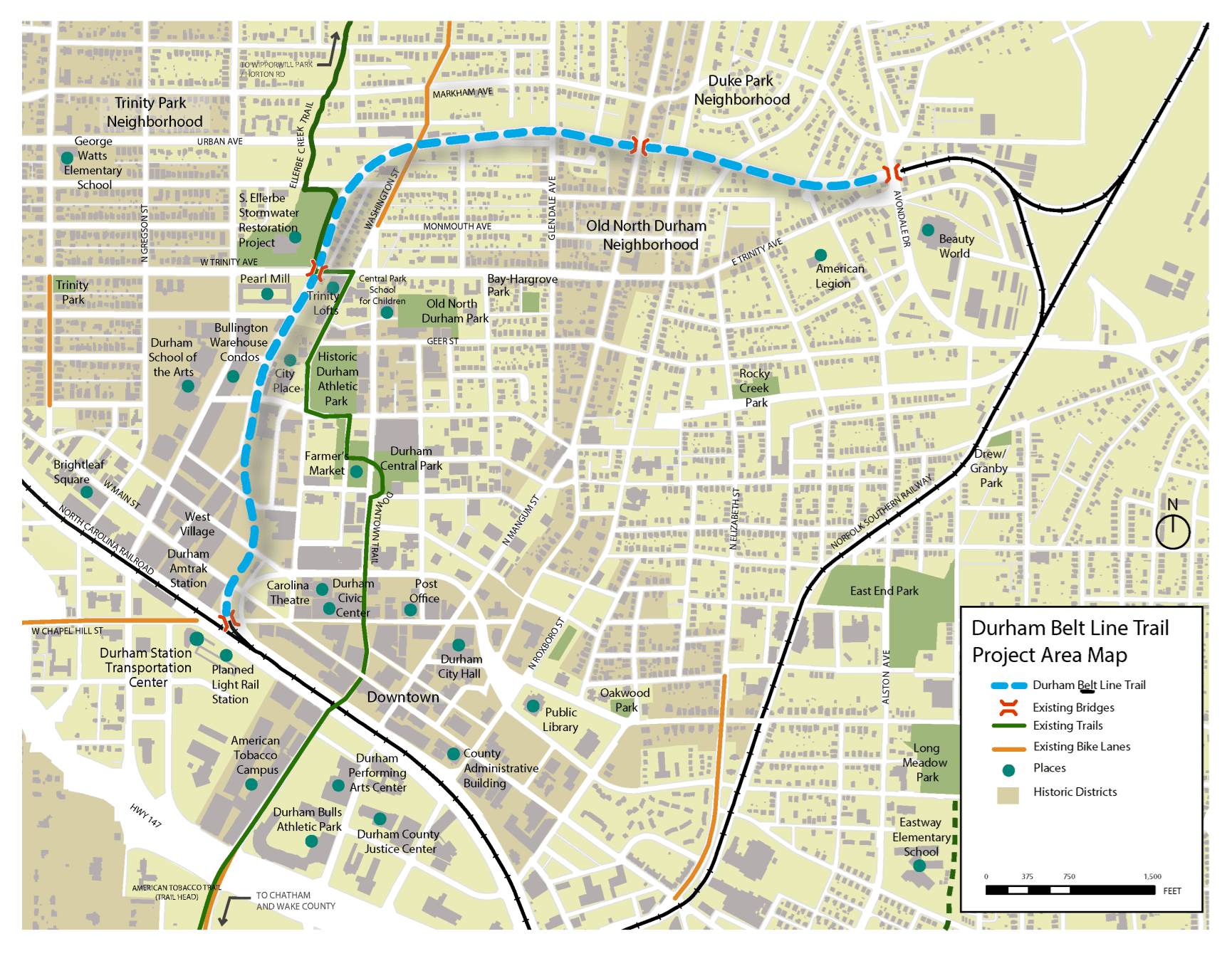
The video shows what most of us already know (as this trail has been in planning for nearly a decade). The trail itself is relatively short. It runs from the downtown train station through West Village, loops through Pearl Mill Village, crosses Washington Street, and eventually turns east toward Old North Durham. One day, as the plan implies, it might circle around to Golden Belt, but that rail spur is still (lightly) active with a train or so a week serving a concrete mill.
It’s a beautiful plan—well-rendered, ambitious, and clearly expensive.
My fear with projects like this is that they skip the learning-as-you-go process.
I don’t oppose the project. I’m glad to see it finally moving after years of delay. But I have to admit: the way this project has evolved runs counter to my values.
THE DELINQUENT CASE FOR INCREMENTALISM
As many of you know, I teach with the Incremental Development Alliance, and I believe cities grow best organically—through many small, steady steps rather than rare, massive, media-tailored ribbon-cuttings. Infrastructure, unfortunately, is almost always the latter kind. Governments tend to build in big, expensive bursts, while citizens tend to build smaller and smarter.
My fear with projects like this is that they skip the learning-as-you-go process. If we had simply cleared and paved the trail ten years ago, we’d have a decade of local life layered in by now: pop-up gardens, food stalls, maybe a café or two, and small homes along the edge. That would have been more Durham.
The McAdams plan is undeniably polished. I just worry it won’t feel like ours.
I hope I’m wrong. After all, the High Line in New York was a big, bold project—and yet it somehow captured its neighborhood’s spirit.
For what it’s worth, I’ve never believed The Durham Rail Trail is a transportation play. Though it is often pitched in public meetings as “transit”, the Rail Trail doesn’t connect major destinations; it winds through beautiful but relatively low-density neighborhoods. It’ll be an amenity, a very nice one at that, but it is not a commuter route, and I found it misleading when people pitched it as that.
WHERE’S THE BEEF / HOUSING?
What disappoints me most is that the city hasn’t pursued housing opportunities along the corridor—something I’ve been urging for years. Every time I’ve raised the issue in public forums, the conversation gets derailed by the usual reflexive slogans, all common nouns: gentrification, equity, affordability. In meeting after meeting, these words get thrown around as tools of obstruction, rarely (if ever) linked to specifics on how we actually do anything about those issues.
As a result, the corridor will mostly remain middle- to upper-end single-family housing, with a few working-class rentals, which will no doubt face accelerated knockdown pressure due to the lack of aggressive new housing construction in the area. It will be the latest death spiral of discourse in Durham- gentrification caused by people complaining about gentrification obstructing the very things that would lessen the existence of gentrification.
In Durham, we’ve inverted logic. And the inversion is leading to a worse city. How does it work? We’re told that adding housing displaces people, and that restricting housing somehow protects renters. Both claims are empirically false, but that’s the discourse we’re stuck in—and the broad acceptance of these inversions functionally means that no new housing will rise along this extraordinary corridor.
That’s a huge loss.
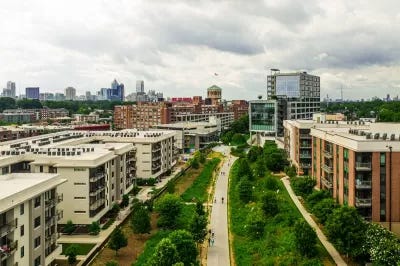
To understand what could have been, just look at Atlanta’s BeltLine: it took the ass end of abandoned industrial buildings and turned them into some of the South’s best urban development. It’s created thousands of new homes, new life, and a clear civic identity. It funded massive parks with district stormwater treatment, which they could afford thanks to new tax revenue from the dense, greenway-oriented development. It’s so successful that they’re now planning to add rail transit to it (which I think is a bad idea, but that’s another story).
After advocating for bike routes, incremental housing, and city action, I don’t see much hope for greenway-oriented development (GOD) in Durham. For those interested in understanding the potential of GOD, check out the series done by Southern Urbanism fellow Sonia Birla.
I AM STILL DREAMING
I am still stuck imagining what could have been: The American Tobacco Trail lined with pocket neighborhoods. And what could be: The Roxboro Rail Trail hosting Copenhagen-style courtyard cohousing. And a holy grail: An East Coast Greenway with little hospitality villages every 50 miles or so, hosting through-cyclists on their way from Key West to Canada with curated local experiences along the way.
But I’ve come to accept that my city isn’t built to think this way. People like me can design, propose, even build these places—but we’ll always be marching uphill against the forever war on some common noun.
In this world, transit and housing are destined to be separated. And housing is bound to be reduced, expensive, and disconnected.
Still, Durham deserves better—and maybe, just maybe, this trail will prove me wrong.
Here’s to the hope.
“ It’s so successful that they’re now planning to add rail transit to it (which I think is a bad idea, but that’s another story).”
Love your work, a bit surprised by this aside. The corridor has *always* been visioned, planned, legislated(the Beltline overlay is the first region in Atlanta to to have no parking minimums), and designed (the ~30’ ROW was proactively purchased and now sits vacant, adjacent to the Beltline) as a greenway transit corridor. Further, in 2016 Atlantans voted for a specialized sales tax for transit expansion (MoreMARTA, includes close to a dozen projects including the nearly completed Atlanta’s first BRT which connects Downtown to the Beltline) and separately, years later, adjacent neighborhoods overwhelmingly reaffirmed their support for the Beltline transit. I’d love to understand your stance here.
Separate from the public and project support, it represents some of the highest pedestrian activity in the city - offices along the corridor boast 33% of employees take alternative modes to work, which is astounding when you note the lack of true transit in the area.
“ it is the presence of heavy pedestrian activity that tindicates a potential for streetcar success” -Jeff Speck, Walkable City
Great post! (aside from the strange note on Beltline light rail, which will be incredible and necessary for ATL)
I lived in Atlanta for a decade and live in Durham now, and am extremely fond of both cities. I really appreciate that Durham has been ambitious about the rail trail from the very beginning in wanting it to be more than just a greenway. It's extremely well positioned to connect the transportation center, Amtrak, multiple parks, and areas like Brightleaf better to downtown, and provide a corridor that connects southern downtown up to the thriving Geer St area.
I totally agree that the city would have majorly benefited from just paving it immediately, or even just laying gravel down like parts of the Beltline have done. Durham really struggles to get projects done in a timely manner. Once projects get to construction they tend to happen pretty efficiently, but the process of planning/fundraising/design/etc seems to take forever and it's common for projects to endlessly slip further back with no accountability. Another good example is the southern boundaries greenway extension, which was supposed otherwise start construction two years ago and is now delayed to at least 2027. When it was brought up to the city council at a recent meeting, they had no idea.
I'm a bit less worried about the rail trail feeling disconnected from the city and too 'planned'. Looking through the actual designs, it's still largely just building out two parks on either end of downtown with art/seating/etc along the way. There are so many great and under-utilized buildings directly adjacent to the trail that I think will have a chance of growing organically. The reality is the initial section of the Eastside Beltline that skyrocketed it into popularity was also VERY planned (Ponce City Market, old fourth ward, etc) though you're right that many sections have grown organically all the way from gravel trail up to thriving small business or arts districts. I do think that having a small slice that demonstrated the vision for the rest of the trail helped those other sections grow organically.
Thanks also for linking to incrementaldevelopment.org. I hadn't heard of it and will be digging into their stuff!