

Mel Brooks turns 100 this week. Six days later, America marks its 250th birthday.
The timing feels almost scripted. The Brooklyn-born son of Jewish immigrants who spent eight decades turning American pretensions, divisions, and sacred cows into unapologetic laughter reaches a century just as the republic he both skewered and celebrated enters its semiquincentennial.
If the 1970s represented a high-water mark for American screen satire, Brooks was its most consistent and fearless practitioner. Saturday Night Live launched in 1975, Americanizing the anarchic no-sacred-cows spirit of Monty Python. But on the big screen, nobody dissected the weird, friction-filled interactions of our unprecedentedly diverse country with the same precision or joy.
Racial, class, regional, religious, philosophical, and wealth differences all got the Brooks treatment—no tribe was exempt, including his own. That comedic openness was far healthier than the repressed, overly sensitive “don’t talk about our differences” system that largely governs discourse today.
Should we bring satire back in its old form?
In this light, Brooks’ films reward a modern urbanist reading. At their core, many mock the absurdities of modern land use politics, power, and institutional detachment—issues that feel freshly relevant in 2026.
Here are my favorite examples:
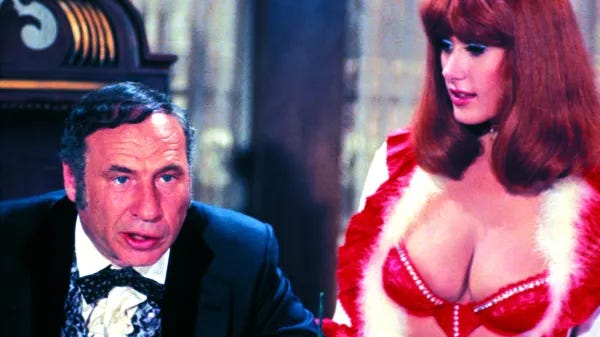
Blazing Saddles (1974) is the clearest and strongest example. The entire plot revolves around a corrupt government official (Attorney General Hedley Lamarr) who schemes to drive residents out of Rock Ridge so a railroad can run through it, enriching himself. It is a satire of land speculation, legal sleights, narrative control, and insider political development deals.
The townspeople, who are presented as inbred, don’t fully grasp the forces manipulating them, while distant power brokers such as Lamarr view the place purely as an obstacle to profit. Brooks exposes how outsider elites treat land as a financial play rather than a lived community, all while the residents’ prejudices, participatory confusion, and buffoonery make them easy marks. The black sheriff Bart (played brilliantly by Cleavon Little) is initially loathed by the townspeople for the color of his skin, but ultimately becomes a hero, organizing the people to fight corrupt government interests, culminating in a surreal fight scene somehow featuring a very gay Dom DeLuise.
One of America’s greatest satires is, at its heart, a story about the problems that arise when self-interested bad-faith people leverage the power of the state to control property that is not theirs, and the need for the people of a place to overcome their differences and fight back. In the end, Hedley Lamarr loses, while Sheriff Bart, The Waco Kid, and the people win.
History of the World, Part I (1981) delivers Brooks’ takedown of centralized bureaucratic power. Just as in the real world, increased government is presumed to be good, but proven not to be. The Roman Empire sequences parody over-centralized planning, sprawling administrative excess, and governments so large and detached that they no longer serve ordinary people. The joke is never cities themselves—it’s what happens when institutions calcify into self-serving machines—“Fuck the poor!”, the Roman commissioners chant in unison, without hesitation or discourse. Urban reformers today make parallel critiques of planning systems that prioritize process over outcomes and distance decision-makers from the communities they supposedly serve.
Young Frankenstein (1974) offers a subtler yet recognizable satire of the dynamics of public discourse. The provincial villagers cling to local traditions, gossip, and resistance to the outsider and his strange innovation. They fear change because it threatens the existing social order. Viewed through a contemporary lens, the torch-wielding mob feels like a zoning hearing of today: you can swap Frankenstein for “developer", and the same “We don’t want your kind here” othering applies.
But different doesn’t mean dangerous, which is the main point of the film. Young Frankenstein captures how local politics too easily descend into hysteria, demagoguery, and fear-mongering; and how conservatism always percolates in the face of change.
The real Mel Brooks urbanist argument emerges across his body of work rather than in any single film. His comedies consistently celebrate what vibrant cities produce: classes, races, and religions colliding, exploring, through humor, the constant friction that naturally arises between diverse groups of people. Blazing Saddles, The Producers, History of the World, Part I, Spaceballs and Robin Hood: Men in Tights all depend on wildly different groups being thrown together. That is fundamentally a city story.
Brooks was a kid from Brooklyn. His comedy only works because America is a messy and diverse place where people from different backgrounds constantly encounter one another. In that sense, his ultimate gift was satirizing the human condition that makes cities necessary and unavoidable.
Much of what Mel Brooks did then would be functionally impossible today. Brooks said so plainly in 2017: we had become “stupidly politically correct, which is the death of comedy.”
“Comedy”, he argued, “has to walk a thin line, take risks. Comedy is the lecherous little elf whispering into the king’s ear, always telling the truth about human behavior.”
SO WHAT? WHAT DO WE DO NOW?
Whatever humor the toxic cultural climate of 2020 didn’t kill, the Trump years complicated in a different way. It is hard to parody a man who already parodies himself as his own hyperbolic caricature. A classic SNL satirical move is to exaggerate the gap between rhetoric and reality, but this tool loses potency when the target has already torched that gap and turned the performance into the point.
The result is a public conversation today that feels humorless and weaponized. We still produce jokes and memes, but the old Brooksian mode—equal-opportunity, risk-taking, aimed at power and pretension rather than the powerless—has become rarer. That matters.
Satire was once the great guardrail of American politics, capable of mocking so ruthlessly that everyone had to take note. Satire cuts through noise. Done well, it can be more penetrating than facts or conventional media because it disarms before it persuades. Laughter creates a brief shared space where defenses drop, and uncomfortable truths can land.
America has always had a tradition of satire and mockery. Satire was often delivered by famous politicians or writers, participants in the argument who understood that, when aimed properly, mockery strengthens rather than weakens a culture. In its original forms, it was the leaders mocking the masses, rather than the other way around.
Benjamin Franklin used Poor Richard character of Richard Saunders as a target to help forge a national snark and disdain for idiots peddling undue hubris. With “The learned fool writes his nonsense in better language than the unlearned, but it is still nonsense,” Franklin mocked the blowhards of his day.
Today’s discourse could use more of the same corrective. National politics, online participation, and local fights over housing and development are all desperately lacking in satire. NIMBYism, for example, frequently dresses self-interest in the language of “neighborhood character,” environmental stewardship, or equity, all while causing the problems it claims to wants to solve.
We could all use a good laugh.
A Brooksian lens would spot the absurdities on every side: the out-of-town developer’s short-term extraction, the NIMBY activist’s selective framing, the homeowner’s status-quo defense masquerading as high principle.
Satire can not rewrite zoning codes, but it could make all the anti-reform posturing impossible to sustain without permanent embarrassment. An excellent Rolling Stone Essay by Alan Scherstuhl in 2018 pointed out that Walk Hard:The Dewey Cox Story so ruthlessly mocked the formulaic Hollywood approach to music biopics that it ended the genre for more than a decade.
Done well, satire ends stupidity.
So the question on next week’s double birthday is straightforward: Should we bring satire back in its old form?
Let me declare, I am not interested in the sanitized, risk-free version that flatters the existing status quo. Any functional return to satire must be willing to offend in service of the truth about how ridiculous we all are, including the satirist. It will not emerge from institutions optimized for safety or omnicause. It will come from individuals with thick skins, clear eyes, and the old Brooks confidence that making the self-interested (and the holier-than-thou) look silly is a civic contribution.
Thats what Mel Brooks did.
But Mel Brooks did more than entertain. He continued a distinctly American tradition: irreverence toward authority, skepticism toward sacred cows, and generosity enough to let everyone (including the audience) in on the joke.
As we mark 250 years of this improbable American experiment, and 100 years of its greatest screwball comic, the best tribute is not only rewatching the films (though you should). It is clearing a little cultural space for the lecherous elf again—so we can keep laughing, and therefore keep thinking, on our way forward.
Some of the funniest movies ever made. One of the worst aspects of our era is a lack of sense of humor about ourselves. I agree, let’s have more biting satire!
Billionaires for Bush is a great example of using satire for political activism. They'd show up to press events dressed like Mr. Monopoly with signs like, "Leave No Billionaire Behind" and "Corporations Are People Too." Have we had anything like that since? There's so much opportunity for this in urbanist activism.