

At a May 4th public meeting in Marblehead, resident David Modica asked a simple question. It quickly ricocheted across American housing politics.
“Are we kind of being pricks?”
The wealthy seaside town north of Boston was discussing how to comply with Massachusetts’s affordable housing policy (known as 3A, or the MBTA Communities Act) by identifying land that was ostensibly available for multifamily housing. 3A requires 177 cities and towns in the MBTA service area to create at least one zoning district near transit stations where multi-family housing is allowed “as-of-right” (no special permit needed), with a minimum density of 15 units per acre. Communities that don’t comply can lose eligibility for key state funding programs, such as MassWorks, Housing Choice, and Local Capital Projects grants.
Marblehead’s government identified the Tedesco Country Club, a private golf course nobody seriously believes will ever be redeveloped.

In response, Modica said what many people in the room understood, but few were willing to admit aloud.
“So, like this is a way to comply (with state law), without doing any of the (state law) stuff?”
The crowd applauded.
“So, when we are like preserving the character of Marblehead, it’s a bad choice. It’s selfish. We’re doing a bad thing. We’re not doing any housing?”
Then came the line that detonated online.
“Are we kind of being pricks?”
Modica closed the stanza with logic that modern public meetings—which in America are structurally designed to reduce or deny development—are simply not built for:
“Are we trying to do nothing? Cause it seems like we are doing nothing.”
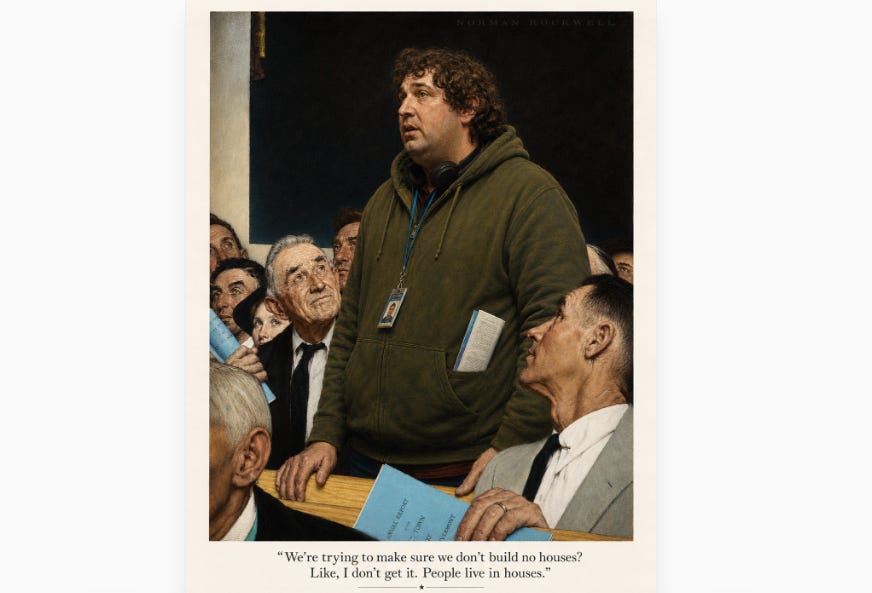
“We’re trying to make sure we don’t build no houses? Like, I don’t get it. People live in houses.”
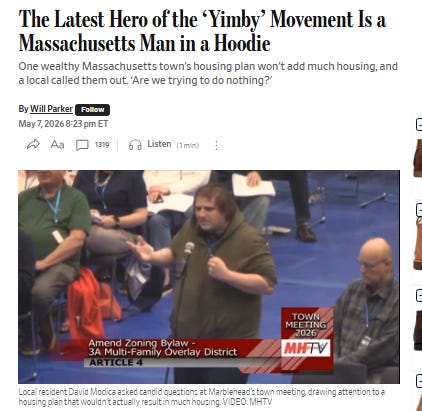
The comments lasted barely a minute. Within 24 hours, social media had transformed Modica into a housing folk hero. The Wall Street Journal covered the moment nationally, noting that his blunt criticism of local housing obstruction had made him “something of a hero” to the YIMBY movement.
“We’re trying to make sure we don’t build no houses? Like, I don’t get it. People live in houses.”
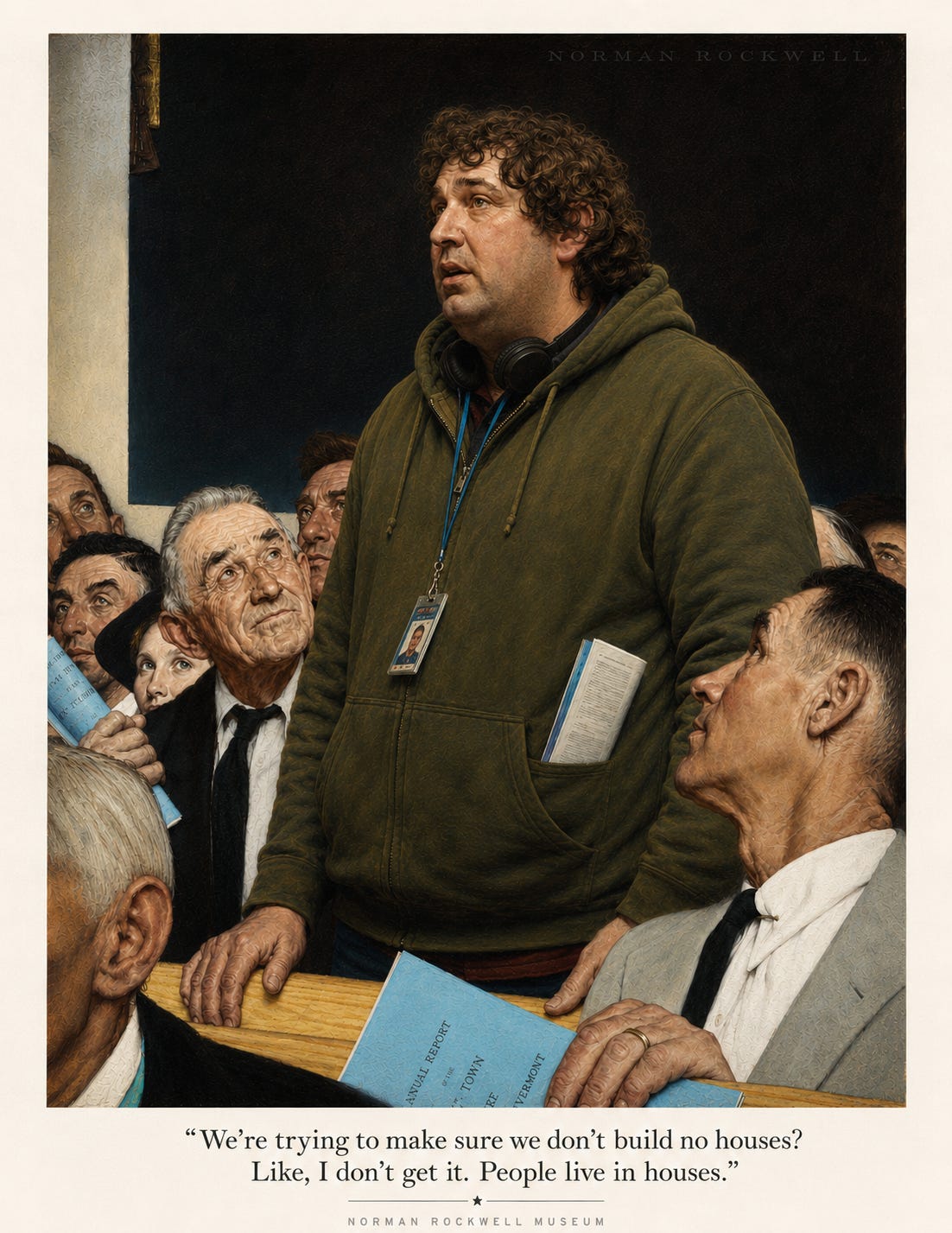
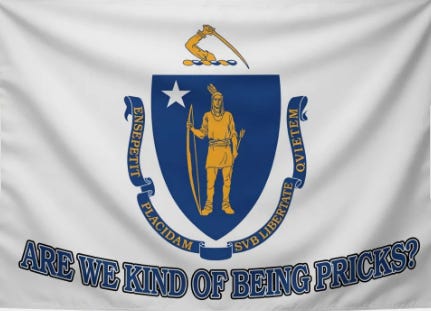
His Massachusetts accent, hoodie, and unfiltered delivery became instant meme material. Norman Rockwell Freedom of Speech parodies appeared online. A fake Massachusetts flag circulated bearing his quote, on-brand for Massachusetts, as a proposed new state motto.
VIBES-BASED PLANNING
The reason the clip exploded is simple: people are exhausted by the feel-good dishonesty ubiquitous within American housing politics.
For decades, many affluent communities have mastered the art of what we in Durham call “vibes-based planning.” The definition is straightforward: “vibes” means that 1) you say something popular but unsubstantive, and 2) what you say does not match what you do.
Specifically, politicians will say all the morally correct things about affordability, sustainability, and community values while quietly structuring policy to do the precise opposite. More specifically, Modica saw it when politicians claimed to care about housing but then voted against it.
The “vibes” imply that promises are decoupled from behavior and that action is discounted to nothingness.
Unfortunately, this pathology has now spread from sea to shining sea. I believe much of it traces back to California, which perfected a kind of virtue-signaling politics in which theatrical performances of caring about housing gradually became more important than the actual construction of housing. The game plan is now visible across the country, and our bluest cities are suffering the results: soaring costs, declining affordability, and an exodus of working- and middle-class residents from some of the nation’s most productive places.
It happens as it did in Marblehead: cities issue declarations about housing crises while banning lower-cost missing middle housing on most residential land. Officials praise the working-class humans they ostensibly serve—teachers, firefighters, and young families—while ensuring those groups cannot afford to live nearby.
THE ROLE OF COLLAPSING MEDIA AND ENGAGEMENT
The reason Marblehead-style vibes-based planning persists is that our ecosystem rewards it.
First, relatively few people understand zoning and land-use policy closely enough to recognize the sabotage when it occurs. There is a significant knowledge gap.
Second, collapsing local media environments often amplify these vibes-based narratives and seem largely incurious about how things work or about actual outcomes. It is easier to write about intentions than to hold leaders accountable for things like permitting times. It is easier to demagogue builders than to understand how minimum lot sizes and single-family zoning destroy opportunity for the least privileged among us. It also hurts that too many young journalists are anti-business (even anti-capitalist) inclined, predisposing them to fall hook, line, and sinker for these pre-packaged NIMBY storylines.
Third, participatory planning processes lack filtering mechanisms to distinguish between civic concern and organized obstructionism. Meetings become dominated by activists with the time, wealth, and political fluency to resist newcomers while still framing themselves as defenders of the public good.
In this environment, a politician can simply claim “I care about affordable housing” and receive applause from residents who are actively fighting affordable housing. Local media will usually be on call to applaud both.
In this ecosystem, no homes need to be built. No contradictions need to be resolved.
And that’s the problem.
BORN-AGAIN YIMBYISM
After half a century of this charade, people are understandably frustrated.
This is the core point of dissatisfaction that was the genesis of the YIMBY movement, now more than a decade old. What began in places like the Bay Area was not originally an ideological project as much as a reaction against obvious and overwhelming civic hypocrisy. Young citizens started attending hearings simply to point out that cities claiming to support affordability were systematically preventing it.
Modica’s comments fit squarely within that tradition.
“Any moment we spend bullshitting each other is just a sin.”
Urbanist writer Nolan Gray later observed that:
“It was refreshing to see such a pure case of classic YIMBYism: Mr. Modica showed up at a hearing packed with NIMBYs, called attention to the absurdity of the situation, and argued for more housing… It was contrarian public comments like this in the Bay Area that kicked off a global movement in the early 2010s.”
A plurality of YIMBY practice remains this simple: show up, expose nonsense. That’s it. Often, the expose is as simple as rebroadcasting the preposterous things NIMBYs say in their lightly attended meetings. Just repeat it. Republish it. More often than not, the statements are so outlandish—as they were in Marblehead—that no further analysis or commentary is needed.
BULLSHITTING IS A SIN
Modica himself later clarified the deeper point behind his remarks: “Any moment we spend bullshitting each other is just a sin.”
That may be the most accurate summary of the modern housing crisis ever spoken into a municipal microphone.
Over the next decade, there will be many more David Modicas, especially in regions where YIMBYism is still politically young, including much of the American South, where the national YIMBYtown conference heads this November.
As I head to Congress for the New Urbanism, I keep returning to the same conclusion: YIMBYism and New Urbanism are not opposing movements but two sides of the same coin.
YIMBYism asks whether we are willing to allow enough housing to exist. New Urbanism asks whether that housing will be lovable, walkable, durable, and humane.
YIMBYism answers whether housing should be allowed. New Urbanism answers what kind of housing should be built.
America needs both.
I refuse to acknowledge that good housing and abundant housing are mutually exclusive, and it is a hill I am willing to die on.
Many of the reforms now associated with YIMBYism—legalizing apartments, reducing parking mandates, allowing mixed-use neighborhoods, permitting incremental infill—were core New Urbanist fights decades before the term YIMBY existed.
The tragedy is that America once routinely built such beautiful workforce housing at scale. The modern “vibes-based planning” system is not preserving this tradition. It is preserving the regulatory abandonment of this tradition.
The false choice between quantity and quality has done enormous damage. Too many people now assume that abundant housing must inevitably be soulless housing, or that beautiful urbanism can only exist in expensive enclaves preserved for the wealthy.
But history says otherwise. Some of the most beloved neighborhoods in America were built as ordinary housing for ordinary people: triple-deckers in New England, courtyard apartments in California, rowhouses in Baltimore, Charleston singles, modest main streets across the South, and thousands of small incremental urban buildings that are now—because of “vibes-based planning”—illegal to construct.
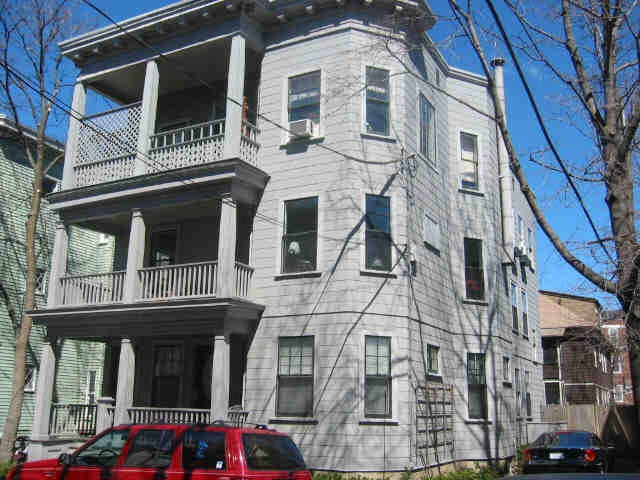
I refuse to acknowledge that good housing and abundant housing are mutually exclusive, and it is a hill I am willing to die on.
I know too many practitioners dedicated to building lower-cost housing beautifully to believe these goals are incompatible.
Fixing it simply requires more people who care and citizens willing to stand up to the bullshitting politicians who do not.
Thank you, Mr. Modica, for reminding us how simple it is to do that.
Boston resident here. I love that people around the country are covering this story about standing up at a town meeting in favor of more housing. Just one note, the Marblehead town planners had meaningfully tried to comply with the law earlier, but one earlier attempt was voted down by town meeting. The next one passed town meeting but was reversed by a special election. So I think the planners are frustrated as well by this result. You hear a planner or selectmen say in response to David Modica, "we tried that (complying) last year and it didn't work." And again at the end you hear Modica saying he doesn't get it, the planner "you're not missing anything here" (i.e., you're right). The planners are frustrated as well, but if they don't pass something in compliance, the town will be punished by withdrawal of certain State funding. Which they DESERVE to be deprived of, along with several other Massachusetts towns!
Thanks for the additional context. I admit when I first saw the clip, it didn't strike me as particularly remarkable. We need more people to stand up to authentically say the quiet part out loud. I'm glad this has gotten the attention it has.